
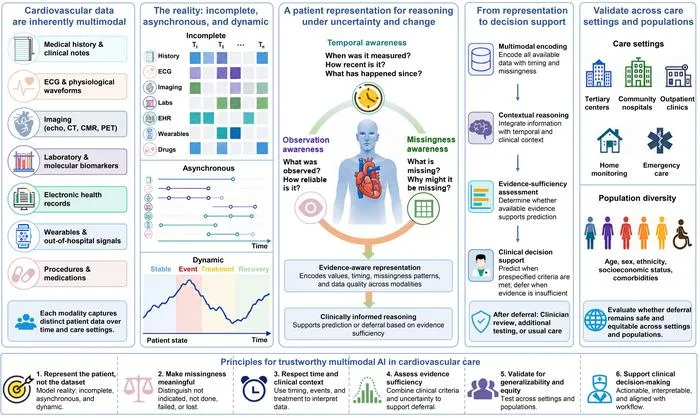
A commentary in Medicine Discovery argues cardiovascular AI models must learn to defer predictions when key modalities are missing, as missingness and asynchrony are clinical realities.
Key Details
- 1Cardiovascular medicine relies on multimodal data (imaging, ECG, labs, records, wearables), but clinical datasets are routinely incomplete and asynchronous.
- 2Five challenges are distinguished: multimodal fusion, missing-modality robustness, temporally-aware modeling, uncertainty-aware selective prediction, and clinical interpretation of unavailability.
- 3Authors advocate treating missing data as clinically meaningful, not just noise, and recommend explicit operational definitions and pathways for model deferral (abstaining from prediction).
- 4Evaluation must cover performance, uncertainty, deferral behavior, generalizability, and equity across settings and patient subgroups, not just benchmark accuracy.
- 5Framework is proposed as a complement to existing clinical AI guidance (e.g., TRIPOD+AI, DECIDE-AI), requiring stakeholder consensus and prospective validation.
Why It Matters
This proposes a practical and conceptual shift for imaging AI in multimodal settings: building for real-world missingness, asynchrony, and deferral, with explicit evaluation of model safety, coverage, and equity. This is essential for reliable translation of AI into complex clinical workflows, especially in cardiovascular medicine where imaging is often part of a fragmented data landscape.

Source
EurekAlert
Related News
•EurekAlert
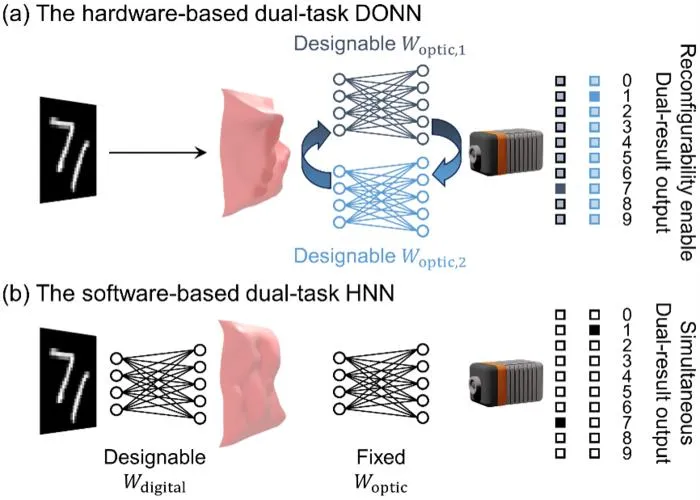
Holographic Neural Network Achieves Multi-Task AI via Light-Based Computing
Researchers have developed a holographic neural network using optics to perform multiple AI classification tasks simultaneously without hardware reconfiguration.
•EurekAlert
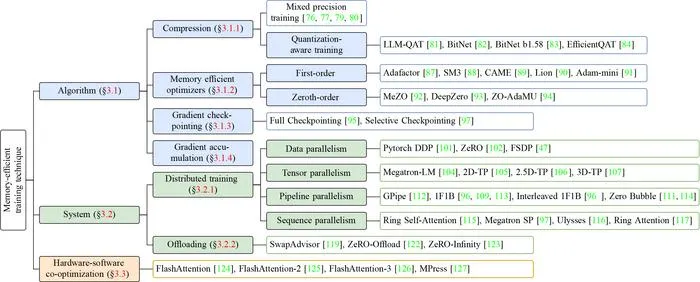
Memory-Efficient Training Approaches for Large AI Models in Science
A systematic review details memory-saving training strategies for large transformer models in scientific fields, including biomedical and medical imaging applications.
•EurekAlert
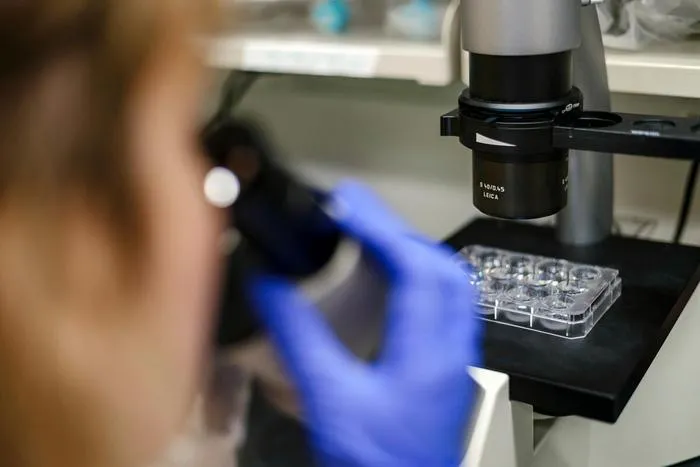
MSKAI Unveils AI Tool for Embryo Cell Analysis and Imaging-Driven Cancer Insights
MSK researchers employ AI and advanced imaging to reveal cancer mechanisms and track embryonic development at the single-cell level.