
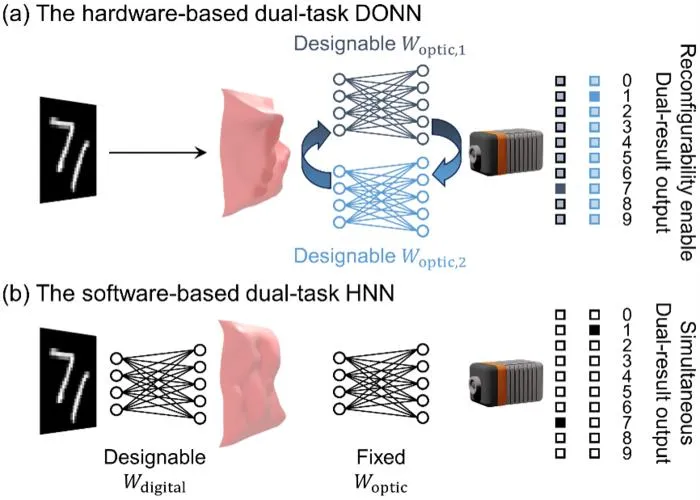
Researchers have developed a holographic neural network using optics to perform multiple AI classification tasks simultaneously without hardware reconfiguration.
Key Details
- 1Conventional optical neural networks require hardware or light property modifications for multi-task processing.
- 2New system uses a single phase-only spatial light modulator and neural holography to encode input and process tasks optically.
- 3System enables simultaneous processing of multiple classification tasks (up to four tasks at ~90% accuracy) without physical reconfiguration.
- 4Joint training algorithm introduces a task correlation factor to suppress task interference and improve accuracy.
- 5End-to-end optoelectronic training enables high alignment between simulation and experiment results.
Why It Matters
Optical AI methods like this could dramatically reduce energy use and latency in AI-powered radiology workflows, and the ability to handle multiple imaging tasks in parallel can enable faster, more flexible systems for medical diagnostics.

Source
EurekAlert
Related News

•EurekAlert
Rethinking Multimodal Cardiovascular AI: When Models Should Defer Predictions
A commentary in Medicine Discovery argues cardiovascular AI models must learn to defer predictions when key modalities are missing, as missingness and asynchrony are clinical realities.

•EurekAlert
MSKAI Unveils AI Tool for Embryo Cell Analysis and Imaging-Driven Cancer Insights
MSK researchers employ AI and advanced imaging to reveal cancer mechanisms and track embryonic development at the single-cell level.
•EurekAlert
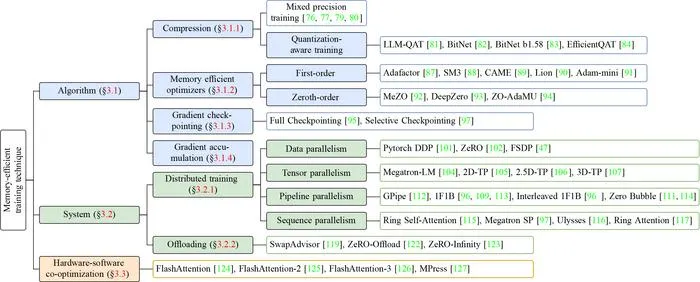
Memory-Efficient Training Approaches for Large AI Models in Science
A systematic review details memory-saving training strategies for large transformer models in scientific fields, including biomedical and medical imaging applications.