
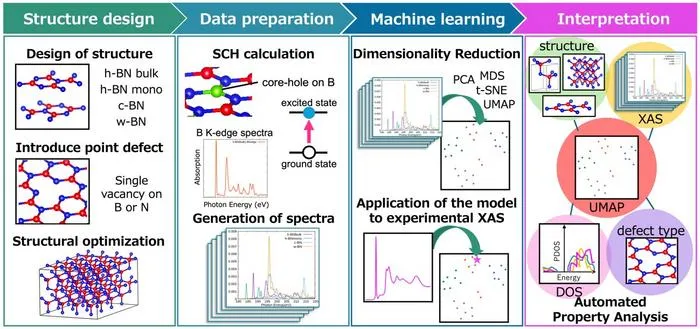
Researchers have developed an AI-based approach to automate and enhance the analysis of X-ray absorption spectroscopy (XAS) data for materials science.
Key Details
- 1X-ray absorption spectroscopy (XAS) is critical for determining materials’ properties but is traditionally labor-intensive and requires expertise.
- 2A Tokyo University of Science team applied machine learning, especially UMAP, to automate analysis and classification of XAS data.
- 3UMAP outperformed other dimensionality reduction techniques in accurately identifying boron nitride structures and defects.
- 4The AI-based system proved robust against real-world noise in experimental XAS data and offers higher accuracy than prior statistical approaches.
- 5The method is being deployed at the Nano-Terasu synchrotron radiation center and is expected to accelerate material design.
Why It Matters
Automating XAS analysis with AI can dramatically speed up and objectify material characterization and design, potentially influencing imaging physics, research, and advanced imaging informatics. This approach demonstrates a broader application of AI to complex imaging data, which could cross-inform developments in radiology AI.

Source
EurekAlert
Related News

•EurekAlert
AI Deep Learning Model Enhances Echocardiogram RV Assessment and Prognosis
Researchers developed DROID-RV, a deep learning tool that automates right ventricular assessment from echocardiograms, showing strong prognostic links with cardiovascular outcomes.

•EurekAlert
Duke Receives $25M to Lead National Trustworthy AI Hub for Dementia and Aging
Duke University has launched a $25 million national center to make AI for aging and dementia clinically robust and trustworthy.
•EurekAlert
Penn Medicine's Percival AI Detects Hidden Health Risks in CT Scans
Penn Medicine's Percival AI leverages CT scans to uncover unseen health risks and disease patterns, expanding the utility of radiological imaging.