
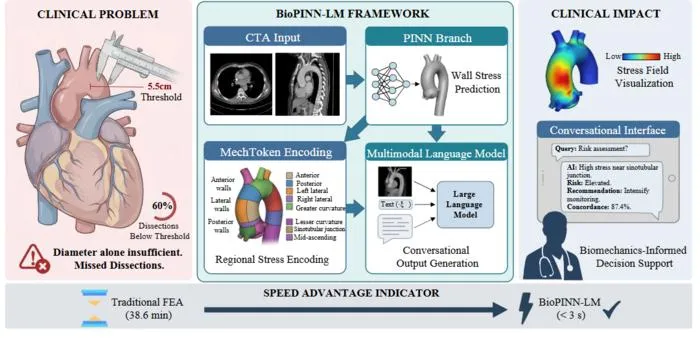
Researchers developed BioPINN-LM, combining physics-informed neural networks and multimodal large language models to deliver fast, interpretable risk assessments for ascending thoracic aortic aneurysms.
Key Details
- 1BioPINN-LM predicts ascending aortic wall stress from CTA-derived geometries, reducing analysis time from 38.6 minutes (finite element analysis) to under 3 seconds.
- 2Framework uses physics-informed neural networks with a hyperelastic constitutive model, and produces region-specific biomechanical biomarkers.
- 3Outputs are integrated with a large language model to generate conversational clinical reports with 87.4% agreement with specialist decisions (F1 score: 0.862).
- 4Tested on 267 geometries, BioPINN-LM achieved mean absolute errors of 8.34–11.07 kPa, outperforming other AI benchmarks.
- 5Work is a prototype; limitations include use of synthetic data, population-average tissue parameters, and lack of validation on real patient outcomes.
- 6Future work will require prospective validation, dynamic stress modeling, and incorporation of clinical outcome data.
Why It Matters
This integrated AI approach could enable rapid, individualized biomechanical risk assessments for aortic aneurysms from routine imaging, addressing limitations of current diameter-based decision-making. If further validated, it may support multidisciplinary heart-team discussions and offer a new paradigm for combining mechanistic simulation with clinical AI.

Source
EurekAlert
Related News

•EurekAlert
Penn Medicine's Percival AI Detects Hidden Health Risks in CT Scans
Penn Medicine's Percival AI leverages CT scans to uncover unseen health risks and disease patterns, expanding the utility of radiological imaging.
•EurekAlert
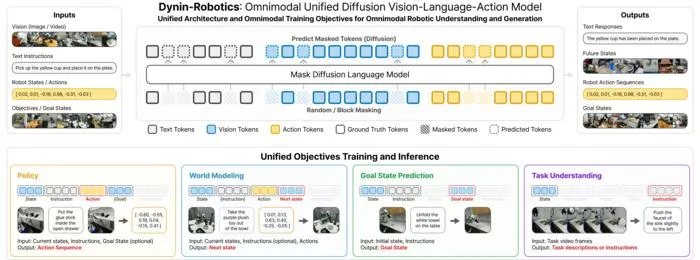
SNU Team Develops Omnimodal AI Model for Robotic Task Control, Eyes Medical Use
SNU engineers unveiled a unified AI model, Dynin-Robotics, that interprets language, predicts outcomes, and executes real-world robotic tasks with potential for medical applications.
•EurekAlert
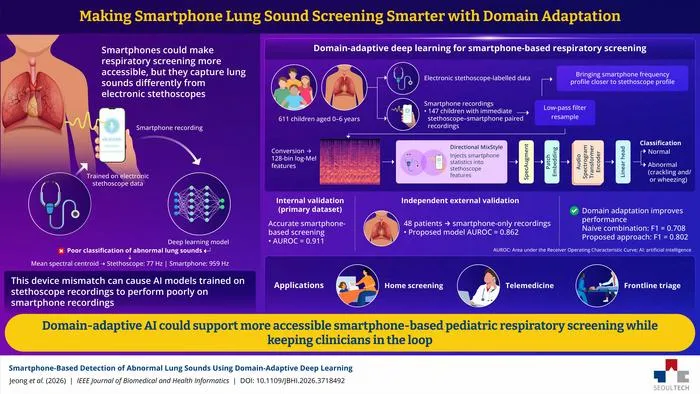
AI Framework Adapts Smartphone Audio for Pediatric Lung Sound Screening
Researchers developed a domain-adaptive deep learning model enabling smartphones to detect abnormal lung sounds in children for remote screening.