
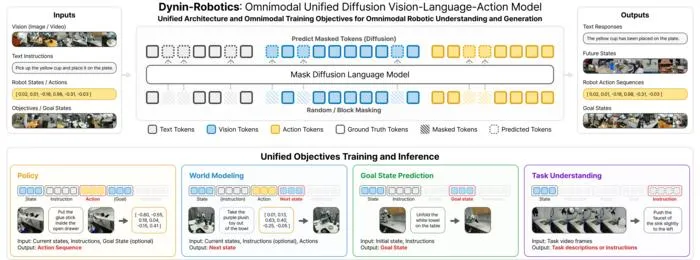
SNU engineers unveiled a unified AI model, Dynin-Robotics, that interprets language, predicts outcomes, and executes real-world robotic tasks with potential for medical applications.
Key Details
- 1Dynin-Robotics integrates language, vision, and action data into a single model.
- 2The model predicts future scenes and uses this for better action planning.
- 3In four real-world tasks, Dynin-Robotics achieved a 78.4% average success rate, outperforming commercial models from NVIDIA and Physical Intelligence.
- 4Improvements include up to 29.2x faster action generation than previous versions and up to 36.6x faster than benchmarks.
- 5Future development includes testing for medical robots (surgical, endoscopic) and applications in manufacturing and logistics.
- 6Research collaboration is ongoing with SNU College of Medicine for medical robotics.
Why It Matters
Unified AI models that combine perception, language understanding, and action prediction could transform not just industrial robotics but also medical and surgical assistance robots, including endoscopics. Robust task understanding and fast planning are crucial for advancing medical AI applications in complex and dynamic environments.

Source
EurekAlert
Related News

•EurekAlert
Penn Medicine's Percival AI Detects Hidden Health Risks in CT Scans
Penn Medicine's Percival AI leverages CT scans to uncover unseen health risks and disease patterns, expanding the utility of radiological imaging.
•EurekAlert
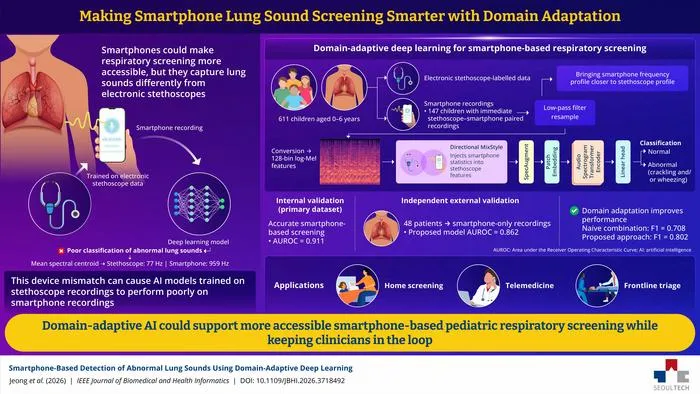
AI Framework Adapts Smartphone Audio for Pediatric Lung Sound Screening
Researchers developed a domain-adaptive deep learning model enabling smartphones to detect abnormal lung sounds in children for remote screening.
•EurekAlert
AI Tool Predicts Stroke Risk by Analyzing Genomic Data, Eyes Imaging Next
Researchers developed a transformer-based AI model to predict ischaemic stroke risk using genetic data, with plans to integrate imaging.