
A new study validates the Sybil AI model for predicting lung cancer risk using low-dose CT in a predominantly Black cohort at an urban safety-net hospital.
Key Details
- 1Study presented at the 2025 IASLC World Conference on Lung Cancer.
- 2Validation conducted at UI Health on 2,092 baseline low-dose CT scans from 2014-2024.
- 3Cohort primarily Non-Hispanic Black (62%), with 13% Hispanic and 4% Asian.
- 4Sybil demonstrated strong Area Under the Curve (AUC): 0.94 (1 yr), 0.90 (2 yr), 0.86 (3 yr), 0.85 (4 yr), 0.80 (5 yr), 0.79 (6 yr).
- 5Results remained strong after restricting to Black participants and excluding recent diagnoses.
- 6The Sybil Implementation Consortium will advance to prospective clinical trials for clinical workflow integration.
Why It Matters
Demonstrating reliable AI performance in racially and socioeconomically diverse settings is crucial for equitable lung cancer screening. This validation may facilitate broader adoption and help address longstanding disparities in lung cancer outcomes.

Source
EurekAlert
Related News
•EurekAlert
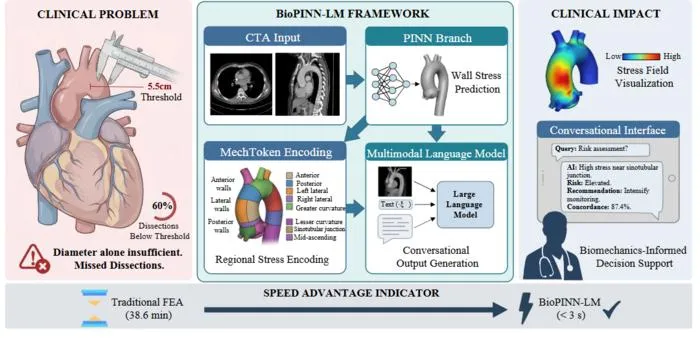
AI Framework Accelerates Aortic Aneurysm Risk Prediction from Imaging
Researchers developed BioPINN-LM, combining physics-informed neural networks and multimodal large language models to deliver fast, interpretable risk assessments for ascending thoracic aortic aneurysms.

•EurekAlert
AI Highlights Importance of Thymus Protection During Lung Cancer Radiotherapy
AI analysis reveals that radiation exposure to the thymus during lung cancer treatment may worsen patient outcomes.
•EurekAlert
Deep Learning Shows Superior Sensitivity in Sinus Disease CT Changes
Automated deep learning achieves greater sensitivity in detecting treatment-related changes in chronic sinus disease on CT scans than standard visual scoring.