
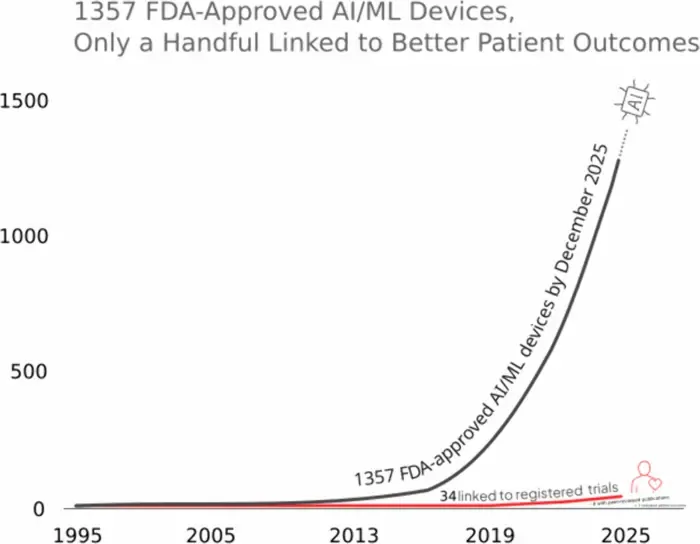
An analysis found that out of 1,357 AI-enabled medical devices cleared by the FDA, only three were actually tested for their effect on patient health outcomes.
Key Details
- 11,357 FDA-cleared AI medical devices were analyzed.
- 2Only 34 devices had associated registered clinical trials.
- 3Just 3 devices were tested for patient-centered outcomes like survival or quality of life.
- 4Most studies excluded groups like pregnant women, older adults, and non-English speakers.
- 5Current FDA clearance requires 'substantial equivalence,' not proven patient benefit.
- 6Authors propose new frameworks for requiring outcome-based evidence across diverse populations.
Why It Matters
Most AI devices, including those used in imaging and diagnostic support, are authorized without proof that they improve real-world patient outcomes. This policy gap is significant for radiology, as clinical validation is crucial for responsible AI deployment and patient safety.

Source
EurekAlert
Related News

•EurekAlert
AI Model Combines ECG and Blood Tests to Spot Heart Transplant Rejection
An AI model integrating ECG data and blood biomarkers predicts heart transplant rejection with high specificity, reducing the need for invasive biopsies.

•EurekAlert
NIH Grant Funds AI Tool for Lung Cancer Discovery at Weill Cornell
Dr. Olivier Elemento receives an NIH Pioneer Award to develop an AI-human hybrid platform for cancer research, initially focusing on lung cancer using imaging and tissue data.
•EurekAlert
Study Shows AI Vision Misses Human-Like Perceptual Illusions
A York University study finds that AI vision systems lack the human-like perceptual shifts seen in biological vision during visual illusions.