
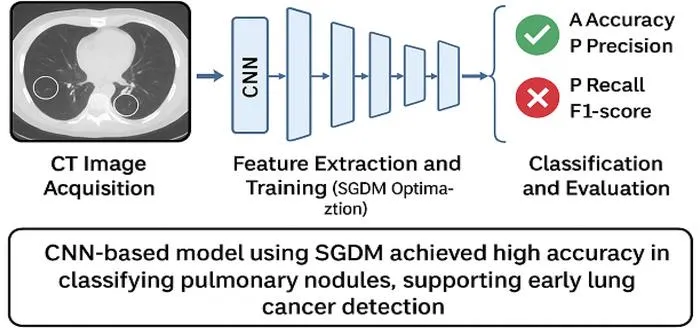
A CNN-based system achieved high accuracy in detecting and classifying pulmonary nodules using LIDC-IDRI CT data.
Key Details
- 1The retrospective study used 10,496 CT slices from 82 LIDC-IDRI patients.
- 2The CNN model consisted of two convolutional layers with 20 and 30 filters and achieved 98.7% sensitivity, 97.5% specificity, 97.9% precision, and 98.4% accuracy.
- 3The method involved preprocessing, segmentation, detection, feature extraction, and CNN-based classification.
- 4Performance was competitive with recent hybrid models but required less computational complexity.
- 5Limitations include validation only on one dataset and a small training size; future work will test other datasets like ELCAP and NELSON.
Why It Matters
Demonstrating robust accuracy with LIDC-IDRI data, the study supports CNN models as promising tools for automated lung cancer screening. Broader validation could accelerate clinical adoption of AI in CT-based nodule analysis.

Source
EurekAlert
Related News

•EurekAlert
AI Heart Age Estimate from Ultrasound Predicts Long-Term Cardiovascular and Dementia Risk
AI-derived heart age from echocardiography images exceeds actual age: linked with higher cardiovascular and dementia mortality over 20 years.
•EurekAlert
Machine Learning Models Improve Mortality Prediction Post-Heart Attack
New machine-learning models outperform traditional risk scores for predicting mortality after a heart attack.
•EurekAlert
MRI Study Reveals Disease Epicenters Driving Atrophy in Multiple Sclerosis
Large-scale MRI analysis identifies specific brain regions acting as epicenters of atrophy in multiple sclerosis patients.