
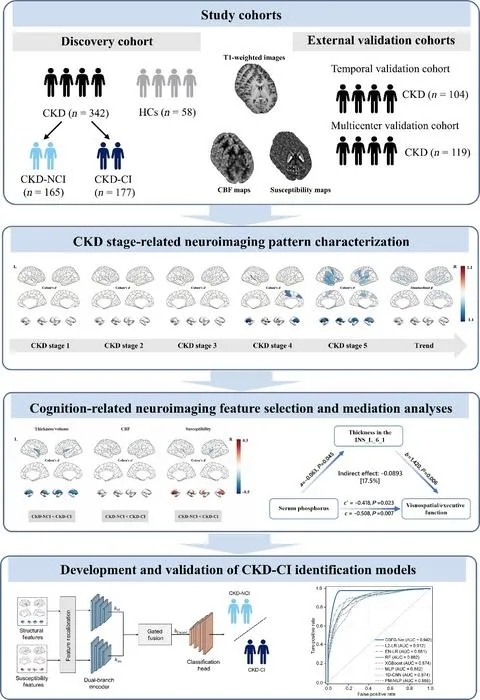
Researchers used multimodal MRI and a novel deep learning model to identify cognitive impairment in chronic kidney disease patients with strong validation.
Key Details
- 1Study integrated T1, ASL, and QSM MRI modalities for brain imaging.
- 2342 CKD patients (177 with and 165 without cognitive impairment) and 58 healthy controls were included.
- 3Feature selection included both CKD stage and cognitive status, yielding 24 key imaging features.
- 4A novel dual-branch feature-gated network (DBFG-Net) achieved AUCs of 0.942 (discovery cohort), 0.902, and 0.926 (external cohorts).
- 5Structural and susceptibility imaging features, not perfusion, were most useful for cognitive status identification.
- 6Study demonstrates robust performance across multiple, independent cohorts.
Why It Matters
This study showcases the potential of advanced deep learning and multimodal MRI for noninvasive identification of cognitive impairment in chronic kidney disease, suggesting a new pathway for early detection and management. The robust, validated methodology may influence future AI diagnostic models and neuroimaging protocols in radiology.

Source
EurekAlert
Related News
•EurekAlert
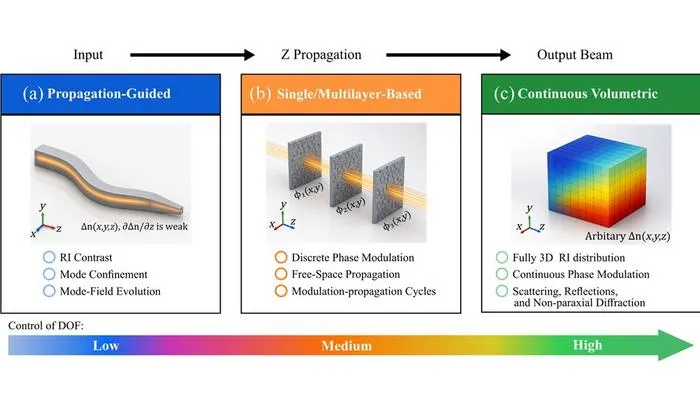
Advances in 3D-Printed Devices for Structured-Light Imaging
Researchers review femtosecond laser 3D microfabrication for integrated structured-light optical devices.

•EurekAlert
Deep Learning Tool Predicts DBS Outcomes in Dystonia via MRI
Researchers developed a deep learning algorithm (DystoniaDBSNet) that uses MRI scans to predict which dystonia patients will benefit from deep brain stimulation (DBS) surgery.

•EurekAlert
HKU Unveils X-ray Telescope and AI Innovations at InnoCarnival 2026
Hong Kong University showcases an X-ray telescope and AI-powered health technologies at InnoCarnival 2026.