
Back to all news
AI Model Improves Differentiation of Brain Tumor Progression from Radiation Necrosis on MRI
A York University-led study shows a novel AI using advanced MRI can distinguish between progressive brain tumors and radiation necrosis more accurately than human assessment.
Key Details
- 1AI model uses attention-guided deep learning with chemical exchange saturation transfer (CEST) MRI.
- 2Study included over 90 patients with brain metastases treated by stereotactic radiosurgery (SRS).
- 3AI achieved over 85% accuracy in distinguishing tumor progression from necrosis, compared to ~60% for standard MRI and ~70% for advanced MRI alone.
- 4Published December 2025 in International Journal of Radiation Oncology, Biology, Physics.
- 5A crucial clinical challenge as treatment decisions for tumor progression vs necrosis are substantially different.
Why It Matters
Differentiating tumor progression from radiation necrosis on MRI post-therapy is a major clinical challenge, as each requires different treatments. AI that improves diagnosis accuracy could substantially impact patient management and outcomes in neuro-oncology.

Source
EurekAlert
Related News
•EurekAlert
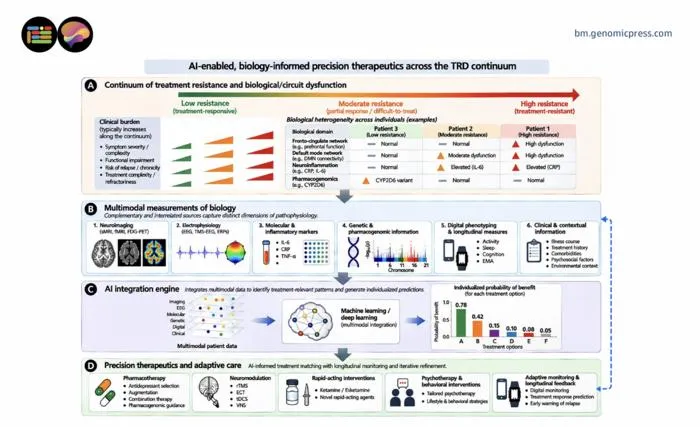
AI and Multimodal Imaging in Defining Treatment-Resistant Depression
A new review highlights AI's promise and current limitations in integrating neuroimaging, EEG, and biological data to improve clinical management of treatment-resistant depression.

•EurekAlert
UC Irvine Unveils AI-Physics Technique to Reconstruct Blood Flow from Imaging Data
UC Irvine researchers developed a physics-guided AI method to more accurately reconstruct cardiovascular fluid flow from imaging data that is sparse or noisy.
•EurekAlert
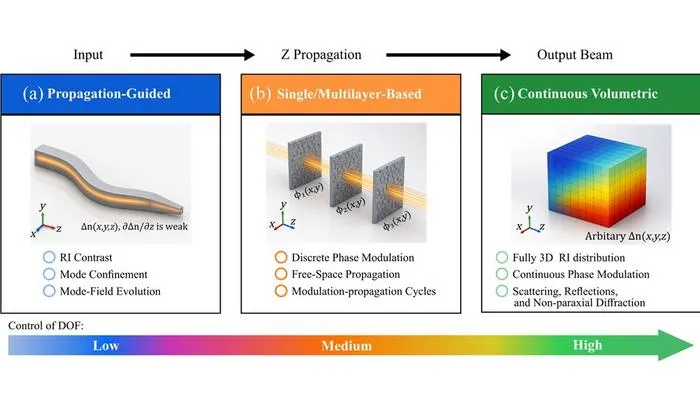
Advances in 3D-Printed Devices for Structured-Light Imaging
Researchers review femtosecond laser 3D microfabrication for integrated structured-light optical devices.