
Back to all news
AI-Enhanced Microfluidic Chip Enables Label-Free Detection of Circulating Tumor Cells
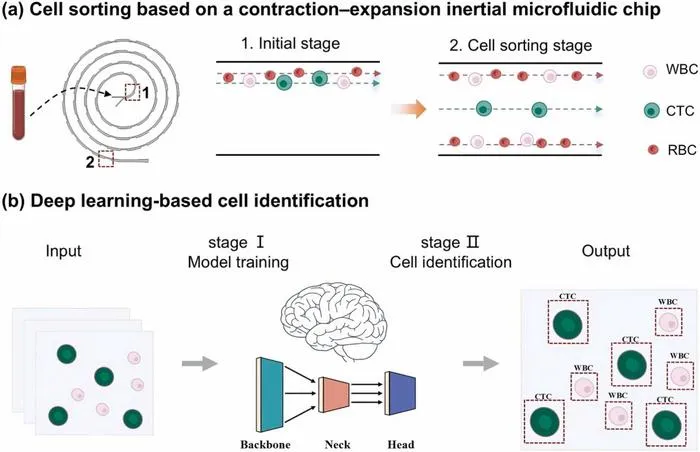
Researchers developed a microfluidic chip and AI system that accurately isolates and identifies rare circulating tumor cells (CTCs) from blood without fluorescent labeling.
Key Details
- 1The platform uses contraction-expansion inertial microfluidics to separate CTCs based on size differences from blood cells.
- 2Identification of enriched tumor cells is performed with the YOLOv8 deep learning model using standard bright-field microscope images.
- 3The system achieved an MCF-7 cell recovery rate of 89.2±3.1% and a white blood cell removal rate of 86.9±1.4%.
- 4YOLOv8 attained 96% accuracy, 94.6% precision and recall, and 95.4% specificity in recognizing tumor cells.
- 5The method eliminates the need for cell-surface marker labeling or fluorescent staining.
- 6Validation was conducted on artificial blood samples, with future studies planned for patient samples.
Why It Matters
This research exemplifies how combining microfluidics with deep learning can significantly improve rare cell detection workflows without needing complex labeling, which could translate into simpler, more robust pathology and liquid biopsy diagnostics for oncology and beyond.

Source
EurekAlert
Related News

•EurekAlert
AI Heart Age Estimate from Ultrasound Predicts Long-Term Cardiovascular and Dementia Risk
AI-derived heart age from echocardiography images exceeds actual age: linked with higher cardiovascular and dementia mortality over 20 years.
•EurekAlert
Machine Learning Models Improve Mortality Prediction Post-Heart Attack
New machine-learning models outperform traditional risk scores for predicting mortality after a heart attack.
•EurekAlert
MRI Study Reveals Disease Epicenters Driving Atrophy in Multiple Sclerosis
Large-scale MRI analysis identifies specific brain regions acting as epicenters of atrophy in multiple sclerosis patients.