
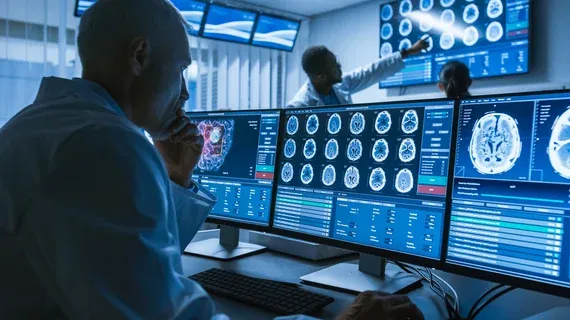
A commercial AI tool for intracranial aneurysm detection outperformed in inpatient and emergency settings but yielded limited benefits for outpatients in a major health system study.
Key Details
- 1Neiman Health Policy Institute evaluated an FDA-cleared AI for intracranial aneurysm detection.
- 2Study analyzed nearly 4,000 consecutive CT angiography scans from a New York hospital system.
- 3AI showed superior performance in emergency and inpatient scenarios, but limited advantage in outpatient cases.
- 4The majority of outpatient AI findings were false positives rather than true positives.
- 5Radiologists were blinded to AI results; about 5% of scans were positive for aneurysm.
- 6Vendor involved was Aidoc; natural language processing was used to compare radiologist and AI findings.
Why It Matters
This study provides crucial data on when AI tools for radiology are most useful in the clinical workflow, spotlighting their highest value in high-acuity settings. These findings guide integration strategy and expectation management for AI deployment across healthcare environments.
Source
Radiology Business
Related News

•Radiology Business
Meta Funds Ohio State’s Radiology AI Innovation Projects
Meta will fund Ohio State researchers to explore AI-driven advancements in radiology, including chest X-ray reporting and disease prediction.
•AuntMinnie
ChatGPT-5 Performs Poorly at Detecting Distal Radius Fractures on X-rays
ChatGPT-5 missed about half of distal radius fractures on x-rays, showing limited diagnostic capability in a real-world scenario.
•AuntMinnie
AI Triage Tool Speeds Up ICH Head CT Turnaround in ED
AI-based triage for intracranial hemorrhage on head CT reduced emergency department report turnaround by 13 minutes.