
Back to all news
Osaka University Unveils Ultra-Fast Self-Evolving Edge AI for Real-Time Medical Devices
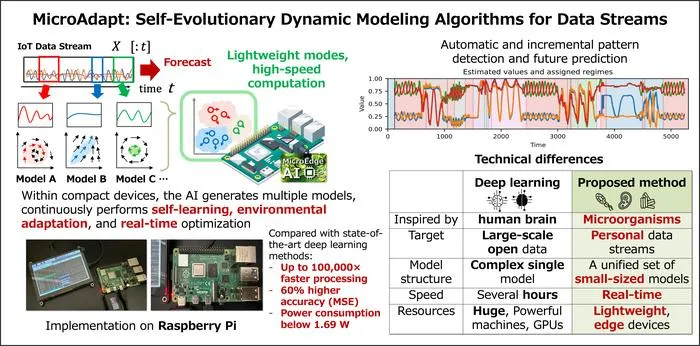
Osaka University researchers launch MicroAdapt, a revolutionary edge AI that brings ultra-fast, accurate real-time learning and forecasting to compact medical and industrial devices.
Key Details
- 1MicroAdapt enables real-time modeling and prediction entirely on compact, resource-constrained edge devices (e.g., Raspberry Pi).
- 2Delivers up to 100,000x faster processing and up to 60% higher accuracy versus leading deep learning solutions.
- 3Reduces memory (≤1.95GB) and power usage (≤1.69W) so it can be deployed on lightweight hardware without GPUs.
- 4System self-evolves: identifying new data patterns and updating models in real time, inspired by microorganism adaptation.
- 5Aim: Overcomes the limitations of cloud-based AI (latency, privacy, power), with applications in healthcare (wearables), manufacturing, and automotive IoT.
- 6Presented at ACM SIGKDD 2025, with ongoing industry collaborations for deployment.
Why It Matters
This advance could shift key AI processing from centralized cloud infrastructure to edge medical and IoT devices—boosting privacy, responsivity, and energy efficiency. For radiology and imaging AI, especially in mobile and wearables, the ability for real-time, adaptive learning on-device enables new frontiers for continuous patient monitoring and diagnostic support.

Source
EurekAlert
Related News
•EurekAlert
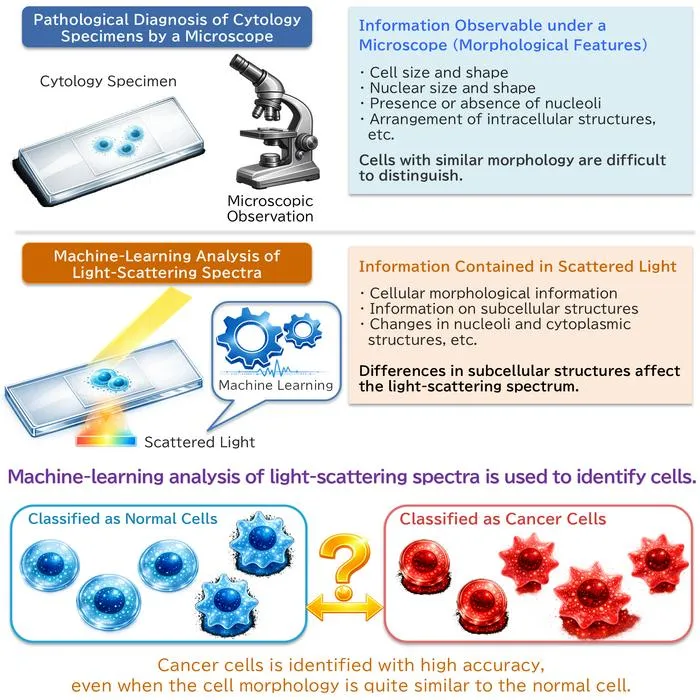
AI System Enhances Cancer Cell Detection via Light Scattering Spectra
Japanese researchers developed an AI system using light scattering spectra to improve cancer cell identification in cytology.
•EurekAlert
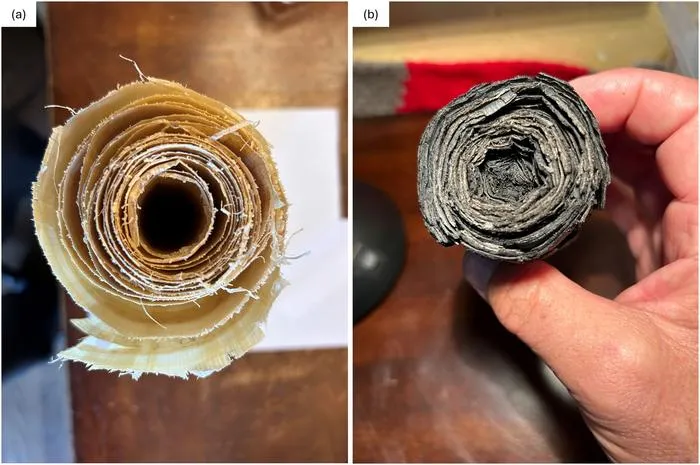
AI and X-ray Imaging Reveal Lost Texts in Ancient Roman Scrolls
AI and x-ray technology enable scientists to virtually read previously unreadable, carbonized Roman scrolls from Herculaneum.

•EurekAlert
AI’s Potential to Expand, Not Shrink, the Clinical Workforce
AI advancements may lead to more, not fewer, healthcare jobs, challenging common fears about workforce reductions in specialties like radiology.