
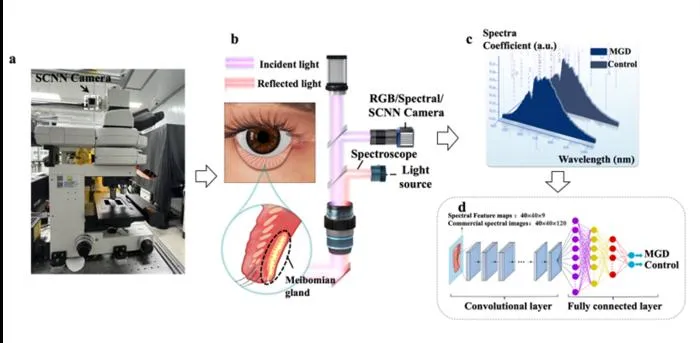
A new metasurface spectral AI chip enables rapid, accurate diagnosis of meibomian gland dysfunction (MGD) from tissue samples, achieving 96.22% accuracy.
Key Details
- 1Researchers from Peking Union Medical College Hospital and Tsinghua University developed a compact optical AI chip for MGD diagnosis.
- 2The AI chip integrates a spectral convolutional neural network (SCNN) directly onto a CMOS imaging sensor.
- 3Pathological tissue sections from MGD patients and controls were rapidly analyzed, producing spectral feature maps in tens of milliseconds.
- 4The chip identifies MGD with 96.22% accuracy, outperforming conventional RGB image analysis (84%) and matching hyperspectral imaging.
- 5Distinct spectral signatures corresponded with disease severity and biochemical changes in gland tissue.
- 6The device is CMOS-fabricated, enabling potential clinical integration for real-time, objective ocular assessment.
Why It Matters
This innovation demonstrates the power of combining metasurface optics and AI for rapid, objective tissue diagnostics—reducing reliance on subjective clinical assessment and paving the way for real-time, in-sensor medical AI applications.

Source
EurekAlert
Related News
•EurekAlert
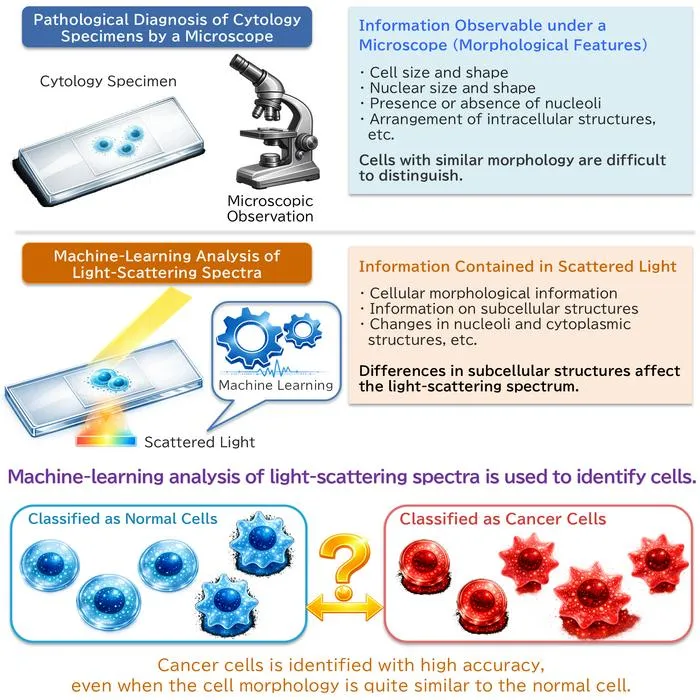
AI System Enhances Cancer Cell Detection via Light Scattering Spectra
Japanese researchers developed an AI system using light scattering spectra to improve cancer cell identification in cytology.
•EurekAlert
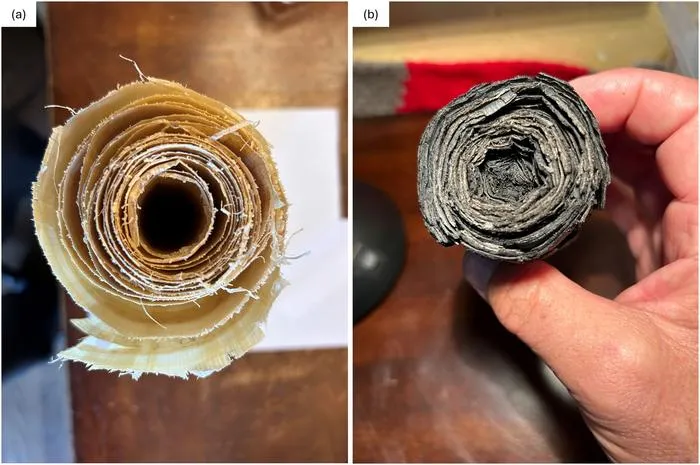
AI and X-ray Imaging Reveal Lost Texts in Ancient Roman Scrolls
AI and x-ray technology enable scientists to virtually read previously unreadable, carbonized Roman scrolls from Herculaneum.

•EurekAlert
AI’s Potential to Expand, Not Shrink, the Clinical Workforce
AI advancements may lead to more, not fewer, healthcare jobs, challenging common fears about workforce reductions in specialties like radiology.