
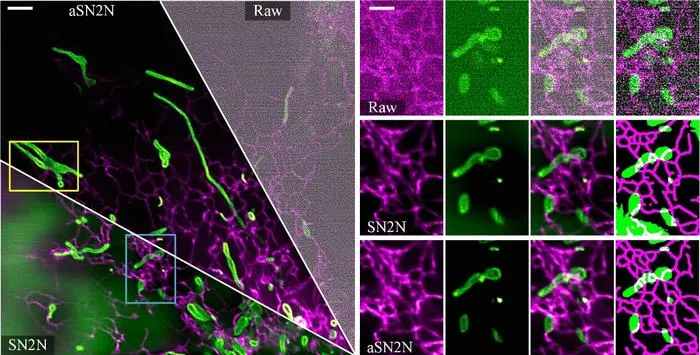
Researchers unveil Adaptive-SN2N, a self-supervised deep learning framework that suppresses background artifacts in super-resolution fluorescence microscopy images.
Key Details
- 1Adaptive-SN2N combines risk-aware adaptive normalization with self-supervised learning and Gaussian-weighted overlap inference.
- 2The framework addresses artifact generation by dynamically selecting normalization strategies based on patch statistics (mean, std, skewness).
- 3It demonstrates significant artifact reduction and improved fidelity in both structured illumination microscopy (SIM) and spinning-disk SIM (SD-SIM) datasets.
- 4Adaptive-SN2N improves segmentation and connectivity detection for live-cell mitochondrial and endoplasmic reticulum imaging.
- 5The method enables 1–2 orders of magnitude greater photon efficiency, enhancing live-cell imaging by reducing phototoxicity and maintaining high SNR.
- 6Broad applicability is anticipated for quantitative image analysis tasks such as segmentation and colocalization.
Why It Matters
Artifact suppression is a longstanding challenge for AI-based microscopy and radiology tools, impacting the accuracy and reliability of quantitative analyses. Adaptive-SN2N’s risk-aware approach can drive more trustworthy interpretations in biomedical imaging and opens doors for safer, high-quality live-cell investigations.

Source
EurekAlert
Related News
•EurekAlert
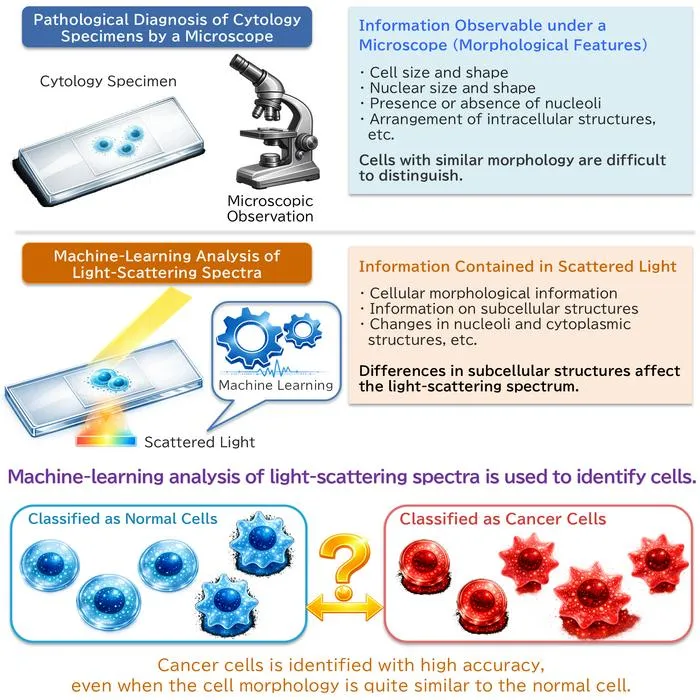
AI System Enhances Cancer Cell Detection via Light Scattering Spectra
Japanese researchers developed an AI system using light scattering spectra to improve cancer cell identification in cytology.
•EurekAlert
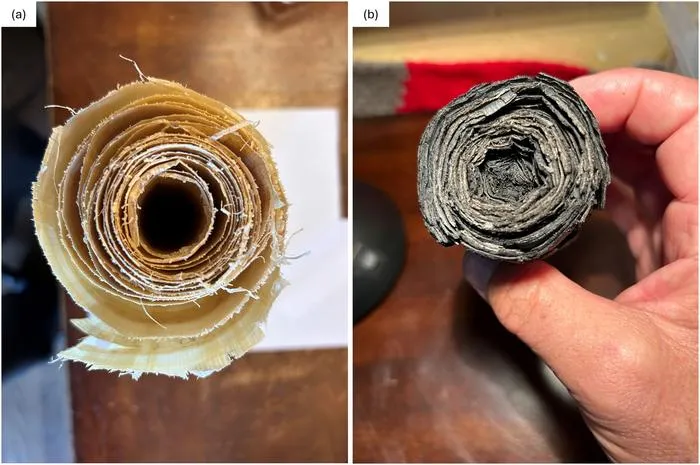
AI and X-ray Imaging Reveal Lost Texts in Ancient Roman Scrolls
AI and x-ray technology enable scientists to virtually read previously unreadable, carbonized Roman scrolls from Herculaneum.

•EurekAlert
AI’s Potential to Expand, Not Shrink, the Clinical Workforce
AI advancements may lead to more, not fewer, healthcare jobs, challenging common fears about workforce reductions in specialties like radiology.