
Back to all news
Large Language Models Rival Physicians in Complex Lung Cancer Decisions
Tags:Research
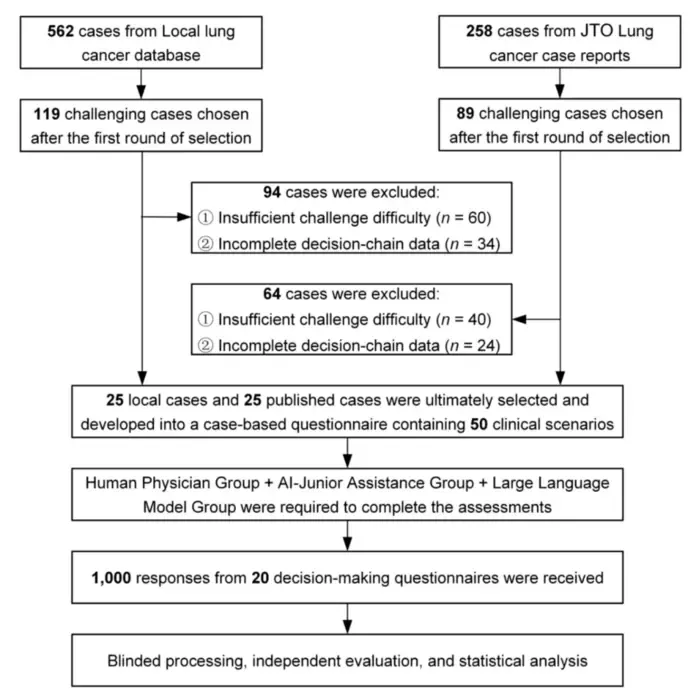
A real-world study reveals that large language models (LLMs) can match or exceed human physicians' performance in challenging lung cancer case decision-making, especially for rare cases.
Key Details
- 150 challenging lung cancer cases (complex, rare, refractory) were evaluated using blinded, multidimensional scoring by experts.
- 2LLMs reviewed: DeepSeek R1, Claude 3.5, Gemini 1.5, and GPT-4o; physician decisions stratified by experience; some juniors received AI assistance.
- 3DeepSeek R1 performed between intermediate and senior physicians overall; LLMs outperformed intermediates in rare cases but lagged in refractory (longitudinal) cases.
- 4AI-augmented junior physicians saw 80-90% boosts in comprehensiveness and specificity for rare cases, but specificity slightly dropped for refractory cases.
- 5Error profiling showed LLMs are strong in knowledge breadth/updates, while physicians excel in longitudinal reasoning and stability.
Why It Matters
This study highlights when and how LLMs can best augment clinical decision-making—showing strong synergies for rare cases and pointing to limitations in complex, longitudinal care settings. These insights will inform the integration of AI tools into radiology and oncology multidisciplinary teams for case-based decision support.

Source
EurekAlert
Related News

•EurekAlert
UVA's $4M NIH Grant Backs AI to Optimize Cardiac MRI Therapies
UVA secures $4 million NIH funding to develop GenStrain, an AI model using MRI data to personalize cardiac pacing therapies.

•EurekAlert
Machine Learning Models Predict Cancer Risk with Routine Health Data
Researchers developed machine learning models using routinely collected health data to predict individual risk for 20 common cancers, outperforming traditional methods for several cancer types.
•EurekAlert
AI Deep Learning Model Enhances Echocardiogram RV Assessment and Prognosis
Researchers developed DROID-RV, a deep learning tool that automates right ventricular assessment from echocardiograms, showing strong prognostic links with cardiovascular outcomes.