
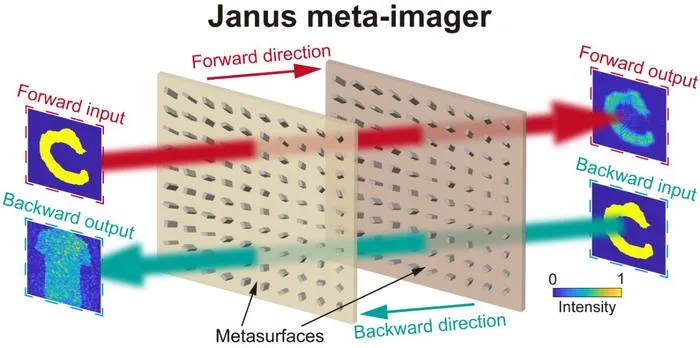
Researchers unveil a passive all-optical device using neural networks for asymmetric image transmission and transformation.
Key Details
- 1Janus meta-imager uses cascaded metasurfaces and diffractive neural networks for image control.
- 2Device can pass images unchanged in one direction and transform them (e.g., letters to icons) in the reverse direction.
- 3Operates passively at high speed (~10 kHz) with minimal energy consumption.
- 4Device size is compact: 0.5 × 0.5 mm²; validated in the near-infrared (800 nm) regime.
- 5Potential applications include optical encryption and direction-dependent data storage.
Why It Matters
The Janus meta-imager exemplifies how deep learning and novel optics can enable new imaging functions without electronics or active power, suggesting future advances for secure medical image transport, coding, and all-optical processing architectures in radiology and related fields.

Source
EurekAlert
Related News
•EurekAlert
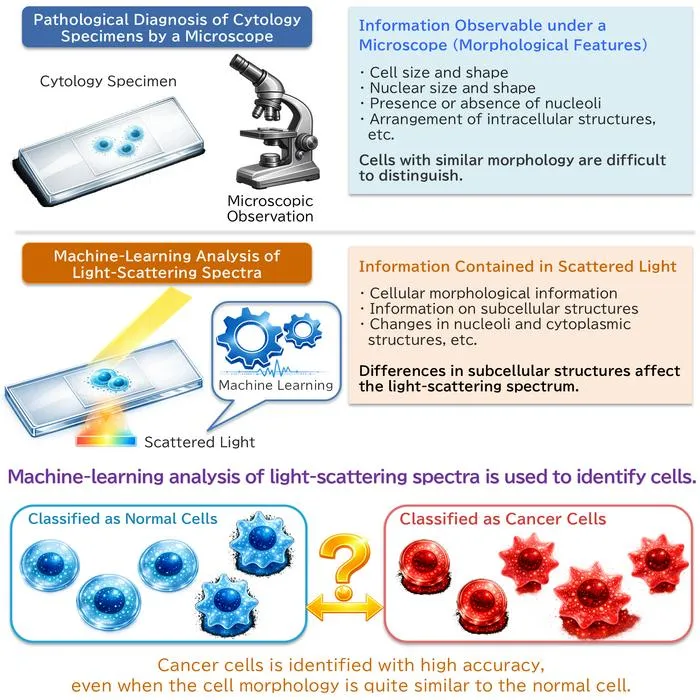
AI System Enhances Cancer Cell Detection via Light Scattering Spectra
Japanese researchers developed an AI system using light scattering spectra to improve cancer cell identification in cytology.
•EurekAlert
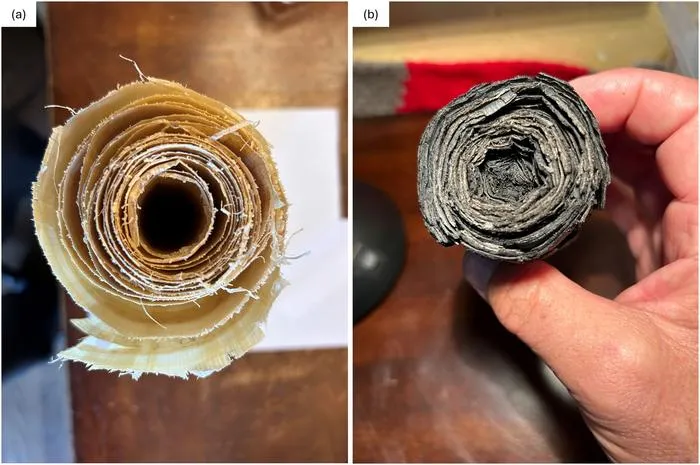
AI and X-ray Imaging Reveal Lost Texts in Ancient Roman Scrolls
AI and x-ray technology enable scientists to virtually read previously unreadable, carbonized Roman scrolls from Herculaneum.

•EurekAlert
AI’s Potential to Expand, Not Shrink, the Clinical Workforce
AI advancements may lead to more, not fewer, healthcare jobs, challenging common fears about workforce reductions in specialties like radiology.