
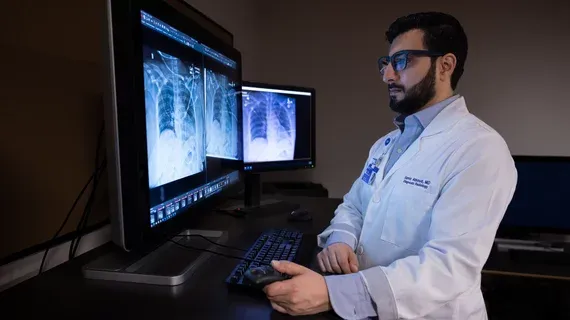
Northwestern Medicine's in-house generative AI boosts radiologist productivity by up to 40% in real-world clinical use.
Key Details
- 1Northwestern Medicine developed and implemented a generative AI system specifically for radiology.
- 2The AI instantly drafts near-complete, personalized radiology X-ray reports for review and finalization by radiologists.
- 3Tested on 12,000 real-world X-ray interpretations, it improved documentation efficiency by 15.5%.
- 4No negative impact was found on clinical accuracy or report quality during deployment.
- 5The AI model is 'lightweight' and tailored to radiology, built using Northwestern's own data rather than adapting commercial LLMs like ChatGPT.
- 6Researchers believe the tool can be commercialized at low cost and holds two patents.
Why It Matters
Demonstrating real-world efficiency gains and seamless clinical integration, this study suggests that tailored, in-house AI solutions can tangibly relieve radiology workload and may guide future AI deployment nationwide.

Source
Radiology Business
Related News

•Radiology Business
Meta Funds Ohio State’s Radiology AI Innovation Projects
Meta will fund Ohio State researchers to explore AI-driven advancements in radiology, including chest X-ray reporting and disease prediction.

•AuntMinnie
ChatGPT-5 Performs Poorly at Detecting Distal Radius Fractures on X-rays
ChatGPT-5 missed about half of distal radius fractures on x-rays, showing limited diagnostic capability in a real-world scenario.
•AuntMinnie
AI Triage Tool Speeds Up ICH Head CT Turnaround in ED
AI-based triage for intracranial hemorrhage on head CT reduced emergency department report turnaround by 13 minutes.