
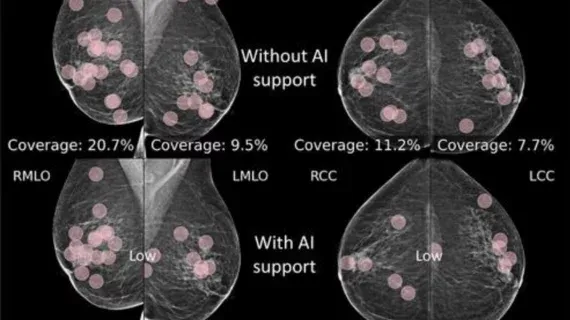
Radiologists using AI visual cues are more likely to identify breast cancers on mammograms, as revealed by eye-tracking analysis.
Key Details
- 1Study published in RSNA's journal Radiology.
- 2Researchers used camera-based eye-tracking to observe 12 radiologists interpreting 150 mammograms (75 malignant, 75 benign).
- 3AI decision support highlighted suspicious areas and assigned malignancy likelihood scores (0-100).
- 4Eye-tracking identified where and how long readers focused on specific image regions with and without AI support.
- 5AI support altered reading patterns and improved cancer detection.
Why It Matters
This study provides concrete evidence that AI tools not only assist radiologists with detection but also change how they visually interact with imaging, which could lead to more effective mammography interpretation and ultimately improve breast cancer outcomes.
Source
Health Imaging
Related News
•Radiology Business
Real-World Study: Radiology AI Best in Emergency and Inpatient Settings
A commercial AI tool for intracranial aneurysm detection outperformed in inpatient and emergency settings but yielded limited benefits for outpatients in a major health system study.
•Radiology Business
New Rubric Enhances Safety of AI-Generated Radiology Summaries
Researchers developed a five-factor rubric to assess the safety and quality of AI-generated, patient-friendly radiology report summaries.

•Radiology Business
UCLA Review Evaluates Breast AI for Early Cancer Detection
A UCLA-led review analyzes current evidence for AI tools in screening mammography, focusing on their capability to detect interval cancers.