
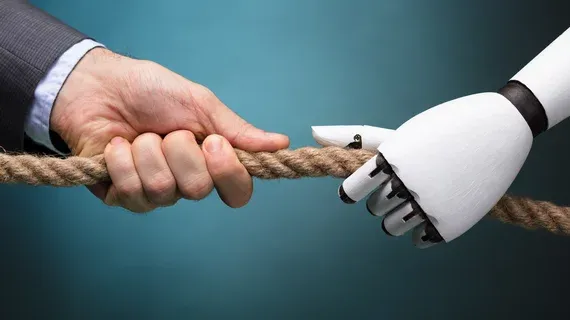
Topol and Rajpurkar propose three models for dividing diagnostic tasks between AI and radiologists to improve workflow outcomes.
Key Details
- 1Eric J. Topol, MD, and Pranav Rajpurkar, PhD, outlined their ideas in a commentary in RSNA's Radiology.
- 2They challenge the traditional 'assistive approach,' citing evidence that integrated workflows don't always enhance results.
- 3Three division-of-labor models are described: AI-first, physician-first, and case allocation based on complexity.
- 4Role separation is promoted to leverage the unique strengths of both AI and radiologists and reduce automation errors.
- 5The authors note that hybrid and adaptive approaches will likely emerge in clinical practice, based on context.
Why It Matters
These recommendations highlight the evolving strategies for effectively integrating AI into radiology practice. Clarifying roles can help maximize clinical benefits and reduce risks such as automation bias or neglect.

Source
Radiology Business
Related News
•Radiology Business
Real-World Study: Radiology AI Best in Emergency and Inpatient Settings
A commercial AI tool for intracranial aneurysm detection outperformed in inpatient and emergency settings but yielded limited benefits for outpatients in a major health system study.
•Radiology Business
New Rubric Enhances Safety of AI-Generated Radiology Summaries
Researchers developed a five-factor rubric to assess the safety and quality of AI-generated, patient-friendly radiology report summaries.
•Radiology Business
AI Model Surpasses Radiologists in Detecting Subtle Hip Fractures
A new AI model outperformed radiologists in identifying difficult-to-detect femoral neck fractures on radiographs.