
German researchers developed a deep learning approach to predict MRI contrast enhancement in brain tumors without the need for gadolinium-based agents.
Key Details
- 1A two-step deep learning pipeline was built to predict contrast enhancement (CE) from quantitative MRI (qMRI) data.
- 2The model used four qMRI parameters: T1, water content, T2*, and quantitative susceptibility map (QSM).
- 346 brain tumor qMRI datasets were used for training, employing a nnU-Net framework with five-fold cross-validation.
- 4The four-parameter model achieved a mean Dice score of 0.60 ± 0.15, outperforming the two-parameter model's 0.52 ± 0.21.
- 5Absence of nonenhancing tumor datasets in training led to false positives; future work aims to improve specificity.
- 6The larger Raccoon AI Brain Tumor Project is expected to provide more data and enable further improvements.
Why It Matters
This AI approach could minimize patient risk by reducing the need for gadolinium-based contrast agents, which carry toxicity concerns. Improved non-invasive CE prediction would represent a major step for safer and more accurate MRI-based brain tumor assessment.

Source
AuntMinnie
Related News
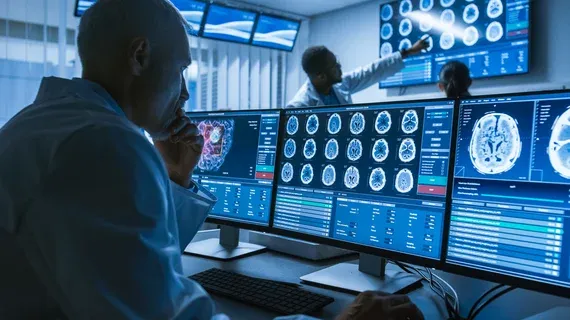
•Radiology Business
Real-World Study: Radiology AI Best in Emergency and Inpatient Settings
A commercial AI tool for intracranial aneurysm detection outperformed in inpatient and emergency settings but yielded limited benefits for outpatients in a major health system study.

•Radiology Business
New Rubric Enhances Safety of AI-Generated Radiology Summaries
Researchers developed a five-factor rubric to assess the safety and quality of AI-generated, patient-friendly radiology report summaries.
•Radiology Business
AI Model Surpasses Radiologists in Detecting Subtle Hip Fractures
A new AI model outperformed radiologists in identifying difficult-to-detect femoral neck fractures on radiographs.