
Back to all news
Deep Learning Model Enables 3D Handheld Photoacoustic-Ultrasound Imaging Without Sensors
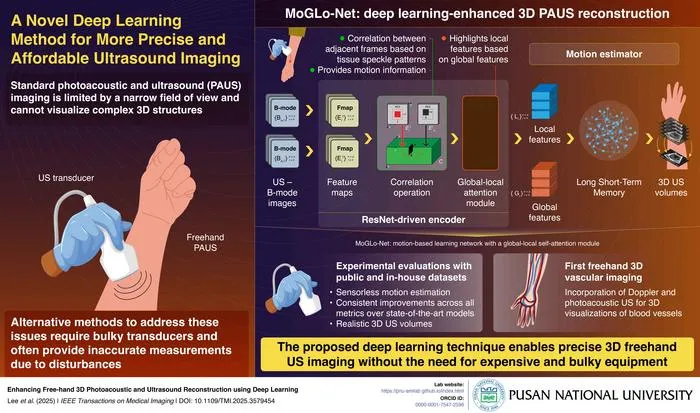
Pusan National University develops MoGLo-Net, an AI model that reconstructs 3D images from handheld 2D photoacoustic and ultrasound scans without external sensors.
Key Details
- 1MoGLo-Net uses deep learning to track handheld ultrasound transducer motion from tissue speckle data, eliminating need for external tracking hardware.
- 2Combines ResNet-based encoder and LSTM-based motion estimator for accurate motion tracking and 3D reconstruction.
- 3Validated using both proprietary and public datasets, outperforming state-of-the-art methods on all metrics.
- 4Successfully achieved 3D blood vessel reconstructions from combined ultrasound and photoacoustic data.
- 5Published June 13, 2025, in IEEE Transactions on Medical Imaging (DOI: 10.1109/TMI.2025.3579454).
- 6Innovation aims to make advanced 3D imaging safer, more accurate, and accessible without costly hardware.
Why It Matters
MoGLo-Net's ability to reconstruct 3D volumes from standard handheld imaging without external sensors could democratize high-end ultrasound and photoacoustic imaging, especially important in resource-limited settings. This advance may enable more effective diagnosis and real-time imaging guidance, expanding access to advanced imaging technologies while reducing costs and complexity of equipment.

Source
EurekAlert
Related News
•EurekAlert
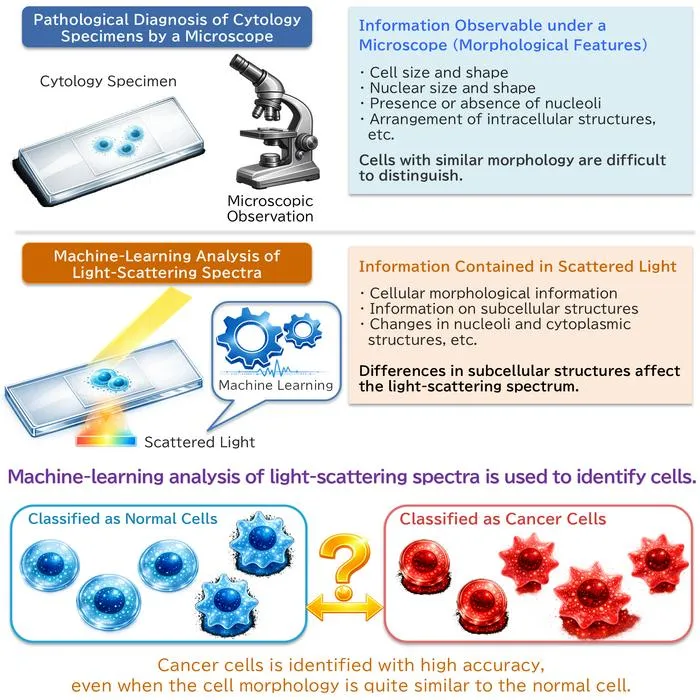
AI System Enhances Cancer Cell Detection via Light Scattering Spectra
Japanese researchers developed an AI system using light scattering spectra to improve cancer cell identification in cytology.
•EurekAlert
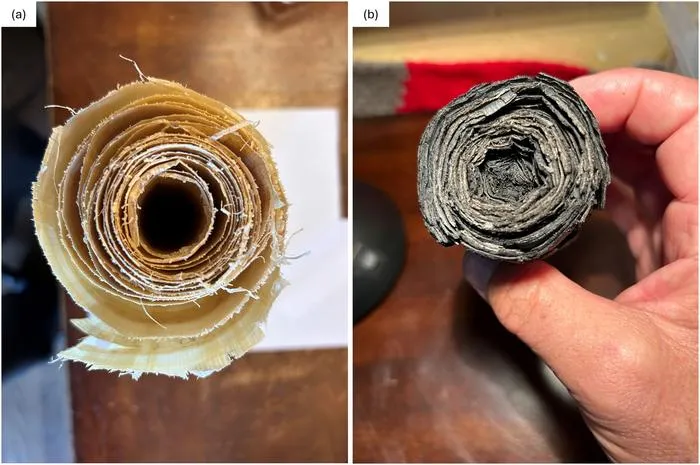
AI and X-ray Imaging Reveal Lost Texts in Ancient Roman Scrolls
AI and x-ray technology enable scientists to virtually read previously unreadable, carbonized Roman scrolls from Herculaneum.

•EurekAlert
AI’s Potential to Expand, Not Shrink, the Clinical Workforce
AI advancements may lead to more, not fewer, healthcare jobs, challenging common fears about workforce reductions in specialties like radiology.