
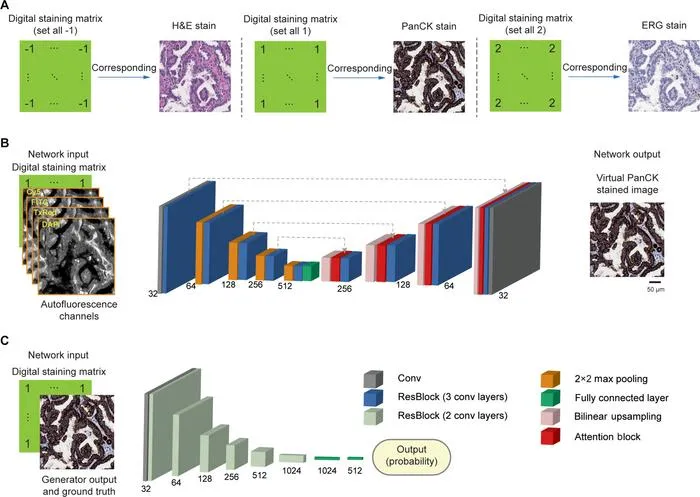
Researchers developed a deep learning framework for generating virtual immunostaining on label-free tissue to assess vascular invasion in thyroid cancer.
Key Details
- 1UCLA-led team created a cGAN-based virtual mIHC model for thyroid cancer assessment.
- 2Framework transforms label-free autofluorescence images into virtual stains for ERG, PanCK, and H&E.
- 3Traditional IHC requires one tissue section per stain and is prone to high cost and variability.
- 4The virtual method achieved high concordance with traditional staining, validated by pathologists.
- 5Virtual stains preserve tissue, reduce cost, and streamline diagnostic workflows.
- 6Blind evaluations confirmed accuracy in identifying vascular invasion.
Why It Matters
This innovation significantly improves efficiency, accuracy, and tissue preservation in pathological cancer assessment—a critical step closely intertwined with radiology and imaging AI. Streamlining virtual staining can broadly impact diagnostic workflows in cancer care and potentially extend to other diseases.

Source
EurekAlert
Related News
•EurekAlert
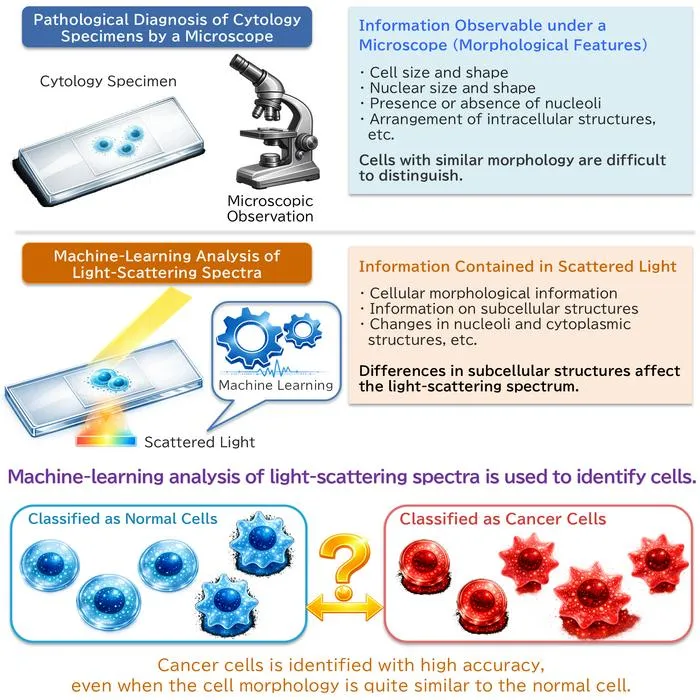
AI System Enhances Cancer Cell Detection via Light Scattering Spectra
Japanese researchers developed an AI system using light scattering spectra to improve cancer cell identification in cytology.
•EurekAlert
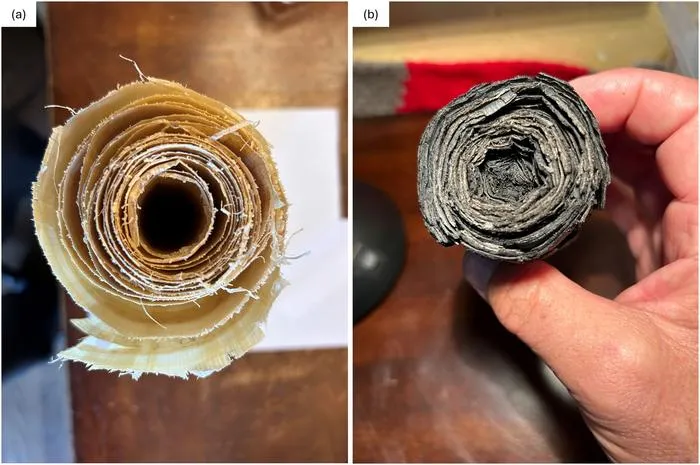
AI and X-ray Imaging Reveal Lost Texts in Ancient Roman Scrolls
AI and x-ray technology enable scientists to virtually read previously unreadable, carbonized Roman scrolls from Herculaneum.

•EurekAlert
AI’s Potential to Expand, Not Shrink, the Clinical Workforce
AI advancements may lead to more, not fewer, healthcare jobs, challenging common fears about workforce reductions in specialties like radiology.