
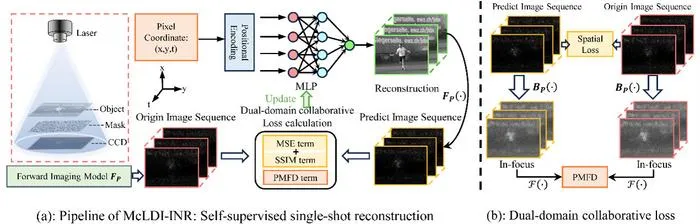
Researchers from NJU and PKU have developed a lensless imaging method using deep learning that reconstructs high-fidelity dynamic images from single shots.
Key Details
- 1New 'McLDI-INR' framework integrates physical models with implicit neural representation for lensless imaging.
- 2Overcomes traditional need for multiple acquisitions and strong priors in dynamic (moving) imaging scenarios.
- 3Uses a binary mask and dual-domain loss (spatial and frequency) to improve image quality and reduce motion blur.
- 4Demonstrated improved reconstruction of moving objects (including biological samples) in both simulation and real-world experiments.
- 5Published in Intelligent Opto-Electronics, June 2026; supported by multiple Chinese science foundations.
Why It Matters
This approach could enable more compact and practical imaging systems, particularly benefiting portable microscopy, dynamic biological observation, and potentially point-of-care medical diagnostics. High-resolution single-shot reconstruction of moving targets is a longstanding challenge, making this advance significant for next-generation imaging AI and device design.

Source
EurekAlert
Related News

•EurekAlert
AI Model Combines ECG and Blood Tests to Spot Heart Transplant Rejection
An AI model integrating ECG data and blood biomarkers predicts heart transplant rejection with high specificity, reducing the need for invasive biopsies.

•EurekAlert
NIH Grant Funds AI Tool for Lung Cancer Discovery at Weill Cornell
Dr. Olivier Elemento receives an NIH Pioneer Award to develop an AI-human hybrid platform for cancer research, initially focusing on lung cancer using imaging and tissue data.
•EurekAlert
Study Shows AI Vision Misses Human-Like Perceptual Illusions
A York University study finds that AI vision systems lack the human-like perceptual shifts seen in biological vision during visual illusions.