
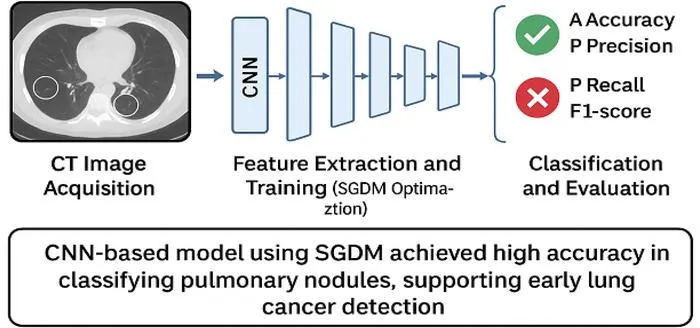
A CNN-based system achieved high accuracy in detecting and classifying pulmonary nodules using LIDC-IDRI CT data.
Key Details
- 1The retrospective study used 10,496 CT slices from 82 LIDC-IDRI patients.
- 2The CNN model consisted of two convolutional layers with 20 and 30 filters and achieved 98.7% sensitivity, 97.5% specificity, 97.9% precision, and 98.4% accuracy.
- 3The method involved preprocessing, segmentation, detection, feature extraction, and CNN-based classification.
- 4Performance was competitive with recent hybrid models but required less computational complexity.
- 5Limitations include validation only on one dataset and a small training size; future work will test other datasets like ELCAP and NELSON.
Why It Matters
Demonstrating robust accuracy with LIDC-IDRI data, the study supports CNN models as promising tools for automated lung cancer screening. Broader validation could accelerate clinical adoption of AI in CT-based nodule analysis.

Source
EurekAlert
Related News
•EurekAlert
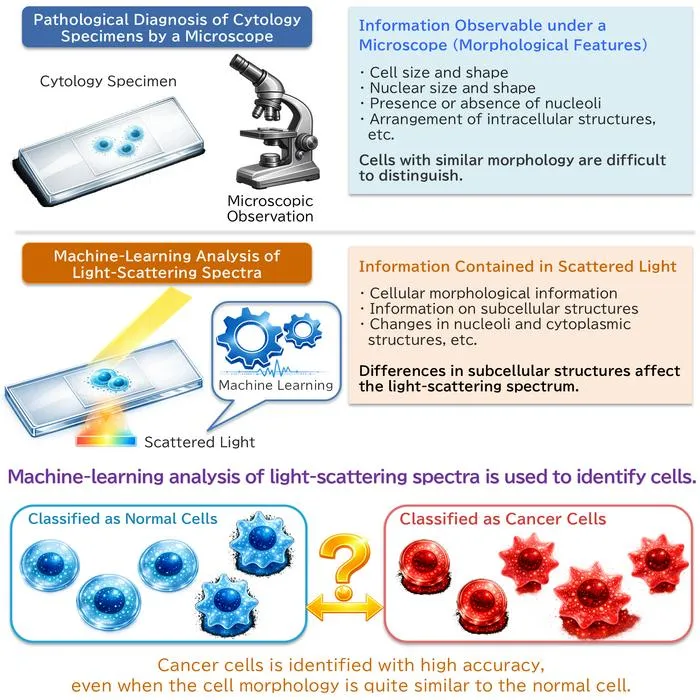
AI System Enhances Cancer Cell Detection via Light Scattering Spectra
Japanese researchers developed an AI system using light scattering spectra to improve cancer cell identification in cytology.
•EurekAlert
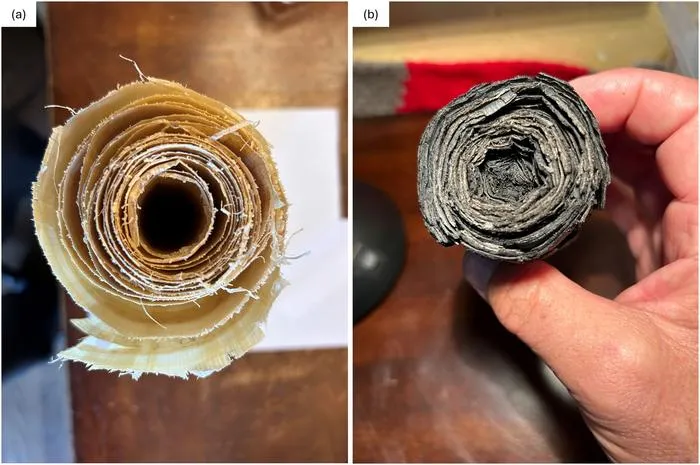
AI and X-ray Imaging Reveal Lost Texts in Ancient Roman Scrolls
AI and x-ray technology enable scientists to virtually read previously unreadable, carbonized Roman scrolls from Herculaneum.

•EurekAlert
AI’s Potential to Expand, Not Shrink, the Clinical Workforce
AI advancements may lead to more, not fewer, healthcare jobs, challenging common fears about workforce reductions in specialties like radiology.