
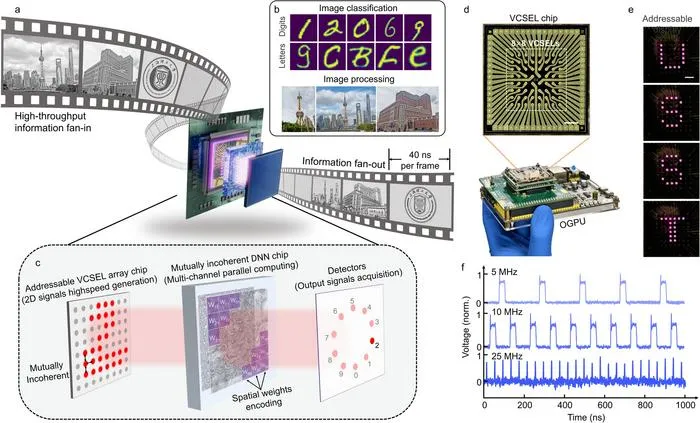
A new photonic chip achieves image processing at 25 million frames per second with high energy efficiency, promising major advances in real-time imaging and AI applications.
Key Details
- 1Vertically integrated photonic chip ('Gezhi') processes 25 million frames per second.
- 2Uses a mutually incoherent VCSEL array and diffractive neural network (DNN) for computation.
- 3Achieved 98.6% accuracy on MNIST image classification benchmark.
- 4Consumes only 3.52 aJ/μm² of optical energy per frame, outperforming electronic accelerators.
- 5Capable of versatile tasks like edge extraction and denoising.
- 6Can be scaled to larger distributed optical computing with tens of thousands of units.
Why It Matters
This technology could enable real-time, low-power AI implementation for high-throughput imaging tasks, which may dramatically enhance the speed and efficiency of image analysis in radiology and medical imaging fields. Its scalability and superior energy efficiency present opportunities for deploying advanced AI in areas such as autonomous diagnostics and smart healthcare.

Source
EurekAlert
Related News
•EurekAlert
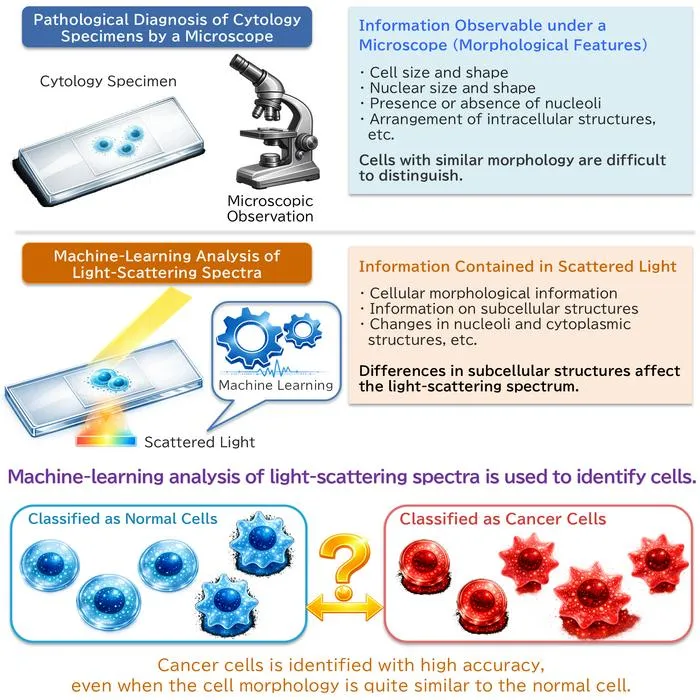
AI System Enhances Cancer Cell Detection via Light Scattering Spectra
Japanese researchers developed an AI system using light scattering spectra to improve cancer cell identification in cytology.
•EurekAlert
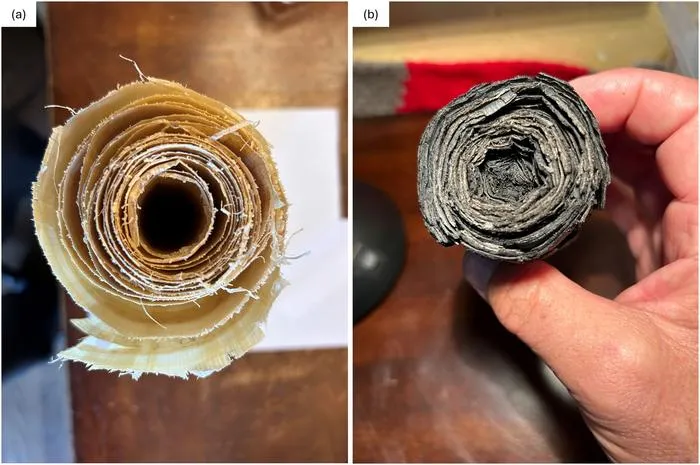
AI and X-ray Imaging Reveal Lost Texts in Ancient Roman Scrolls
AI and x-ray technology enable scientists to virtually read previously unreadable, carbonized Roman scrolls from Herculaneum.

•EurekAlert
AI’s Potential to Expand, Not Shrink, the Clinical Workforce
AI advancements may lead to more, not fewer, healthcare jobs, challenging common fears about workforce reductions in specialties like radiology.