
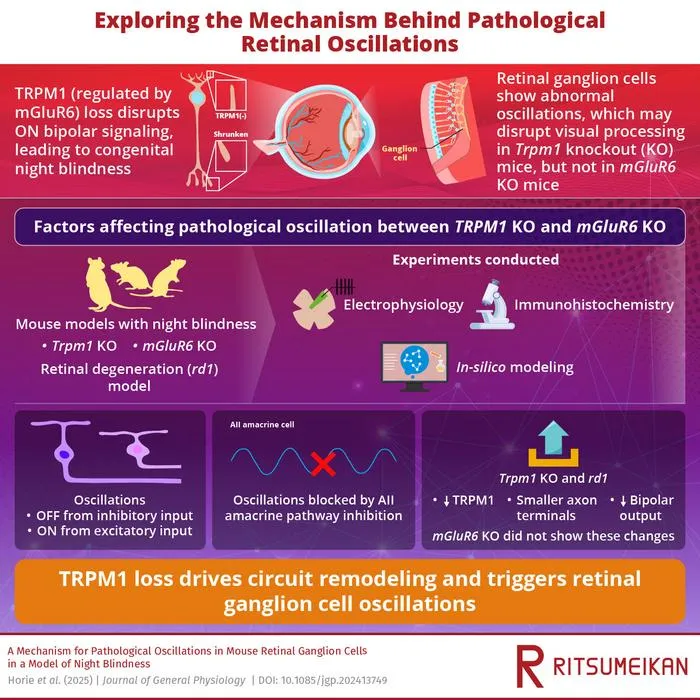
Loss of the TRPM1 ion channel leads to rhythmic retinal signals linked to night blindness and other degenerative eye diseases.
Key Details
- 1The absence of the TRPM1 channel in retinal ON bipolar cells disrupts communication with amacrine cells, causing rhythmic (oscillatory) electrical activity.
- 2Oscillations found in Trpm1 knockout (KO) mice resemble those seen in retinitis pigmentosa model mice, suggesting a shared mechanism.
- 3Structural remodeling of rod bipolar cell terminals and altered inhibitory/excitatory signaling were observed in affected retinas.
- 4Computational modeling confirmed that reduced synaptic strength plus hyperpolarization in ON bipolar cells suffices to trigger pathological oscillations.
- 5These abnormal rhythms disrupt normal visual information processing and may cause hallucinations or degraded vision, impacting potential vision restoration approaches.
Why It Matters
Understanding the cellular origin of retinal oscillations is crucial for improving the efficacy of vision restoration therapies and developing strategies to mitigate neural noise that can distort or degrade visual perception in patients with degenerative retinal conditions.

Source
EurekAlert
Related News
•EurekAlert
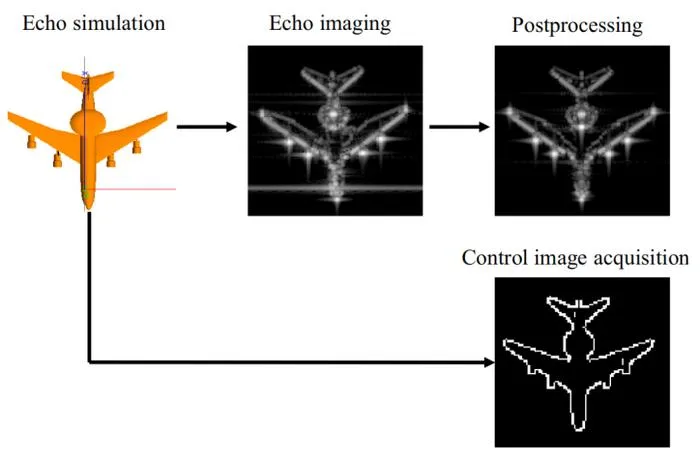
AI Achieves Precision in Generating Radar Images at Specific Attitudes
Researchers introduce a ControlNet-based AI method for precise, attitude-controllable radar image generation of noncooperative targets.
•EurekAlert
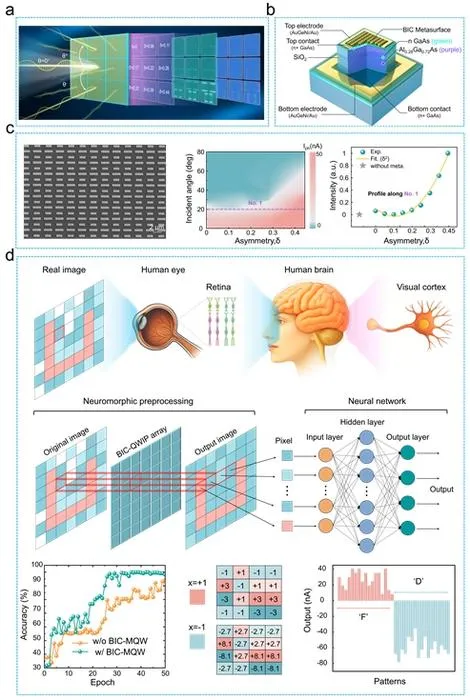
Novel Nanophotonic Chip Enhances Machine Vision with Quantum Wells and Metasurfaces
Researchers developed a nanophotonic processor integrating quasi-BIC metasurfaces with MQWs, demonstrating tunable photoresponse for advanced machine vision.

•EurekAlert
RADAR AI Sets New Standard in Abdominal CT Diagnosis
The RADAR vision-language AI model shows expert-level diagnostic ability for abdominal CT across multiple diseases and clinical settings.