
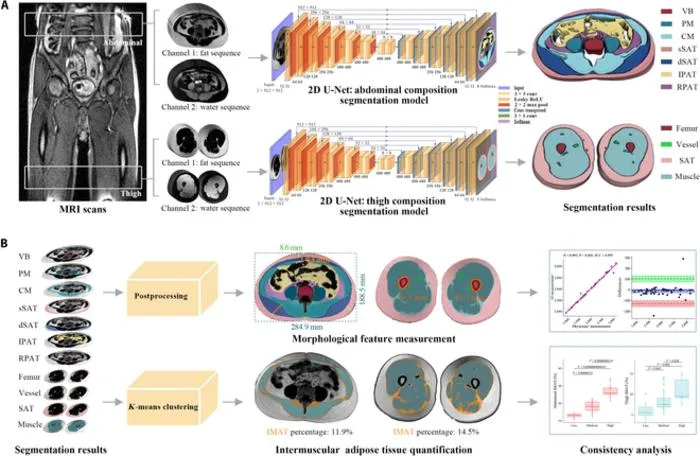
Researchers developed BioCompNet, a dual-sequence AI system that automates body composition measurement from MRI scans for improved cardiometabolic risk management.
Key Details
- 1BioCompNet uses a dual-channel 2D U-Net framework to process fat- and water-sequence MRI for abdominal and thigh segmentation.
- 2It quantifies 15 key body composition components automatically, including muscle, bone, and various fat compartments.
- 3Tested on 503 subjects internally and 30 cases externally, it achieved mean Dice scores of 0.938 (abdomen) and 0.936 (thigh) with strong physician agreement (ICC 0.881–0.999).
- 4Automated processing takes 0.12 minutes per case, compared to 128.8 minutes manually, enabling large-scale studies.
- 5Limitations include the need for broader validation across populations, refinement of clinical integration, and multicenter studies for further generalizability.
Why It Matters
This workflow represents a significant advance in scalable, automated MRI quantitative analysis, potentially enabling precise risk assessment and management for cardiometabolic diseases. It reduces the labor required for body composition measurements, supporting both large-cohort research and future clinical deployment.

Source
EurekAlert
Related News

•EurekAlert
UVA's $4M NIH Grant Backs AI to Optimize Cardiac MRI Therapies
UVA secures $4 million NIH funding to develop GenStrain, an AI model using MRI data to personalize cardiac pacing therapies.

•EurekAlert
Machine Learning Models Predict Cancer Risk with Routine Health Data
Researchers developed machine learning models using routinely collected health data to predict individual risk for 20 common cancers, outperforming traditional methods for several cancer types.

•EurekAlert
Duke Receives $25M to Lead National Trustworthy AI Hub for Dementia and Aging
Duke University has launched a $25 million national center to make AI for aging and dementia clinically robust and trustworthy.