
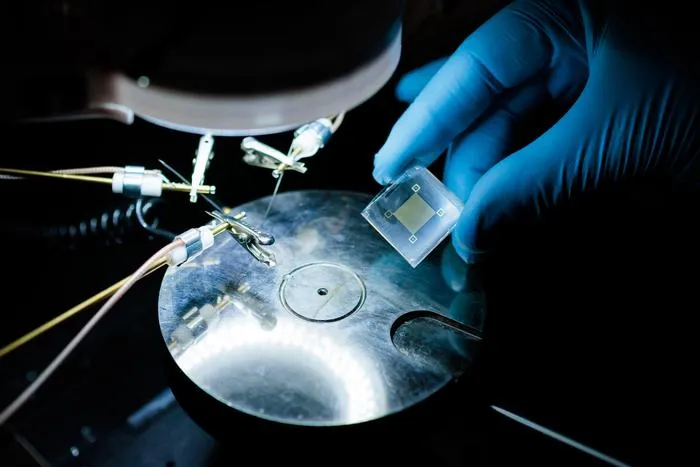
University of Chicago engineers introduce a stretchable skin patch that applies AI to instantly analyze health data on the body.
Key Details
- 1The patch uses organic electrochemical transistors printed onto flexible surfaces, enabling neuromorphic edge computing.
- 2Performs AI-powered analysis directly on-body in milliseconds, eliminating the need for wireless data transfer.
- 3Demonstrated 99.6% accuracy in localizing cardiac electrical wavefronts on real heart data, even when stretched.
- 4The neural network on the device achieved 83.5% accuracy in predicting heart attack risk from combined health data.
- 5Manufacturing breakthrough: 10,000 organic electrochemical transistors per cm² manufactured via UV-patterned polymer gel.
- 6Published May 2026 in Nature Electronics; supported by NIH, ONR, DOE, and others.
Why It Matters
This approach enables rapid, localized AI diagnostics, potentially improving outcomes for life-threatening conditions such as arrhythmias. It advances the field toward smarter, wearable medical devices that could play direct roles in monitoring and even intervening in patient care without offloading data externally.

Source
EurekAlert
Related News

•EurekAlert
UVA's $4M NIH Grant Backs AI to Optimize Cardiac MRI Therapies
UVA secures $4 million NIH funding to develop GenStrain, an AI model using MRI data to personalize cardiac pacing therapies.

•EurekAlert
Machine Learning Models Predict Cancer Risk with Routine Health Data
Researchers developed machine learning models using routinely collected health data to predict individual risk for 20 common cancers, outperforming traditional methods for several cancer types.

•EurekAlert
Duke Receives $25M to Lead National Trustworthy AI Hub for Dementia and Aging
Duke University has launched a $25 million national center to make AI for aging and dementia clinically robust and trustworthy.