
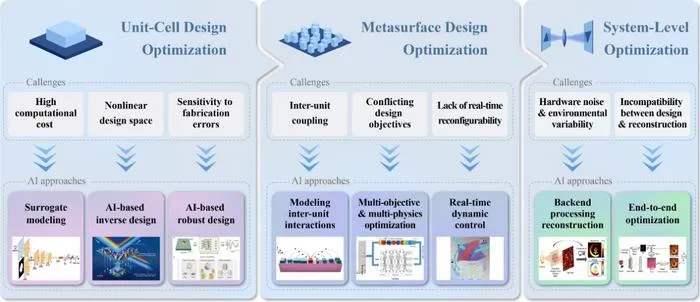
A review highlights how AI is revolutionizing the design of optical metasurfaces, advancing compact optics and computational imaging.
Key Details
- 1AI accelerates unit-cell and system-level metasurface optimization via surrogate modeling, graph neural networks, and reinforcement learning.
- 2End-to-end differentiable frameworks now directly link nanostructure design to imaging application goals.
- 3Key application areas include compact imaging systems, AR/VR displays, LiDAR, and computational imaging.
- 4The review calls for integrating AI with electromagnetic theory and creating unified architectures for multi-scale photonic design.
- 5Led by Prof. Xin Jin of Tsinghua University, with significant contributions to computational imaging.
Why It Matters
AI-driven metasurface technology is poised to enable next-generation compact and computational imaging systems, potentially transforming radiology and medical imaging devices. It demonstrates the expanding role of AI beyond image analysis into hardware and system design.

Source
EurekAlert
Related News
•EurekAlert
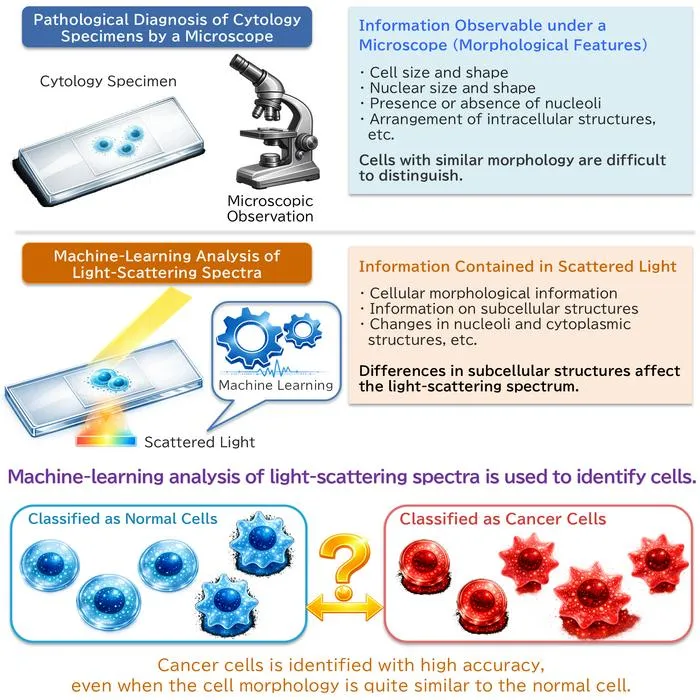
AI System Enhances Cancer Cell Detection via Light Scattering Spectra
Japanese researchers developed an AI system using light scattering spectra to improve cancer cell identification in cytology.
•EurekAlert
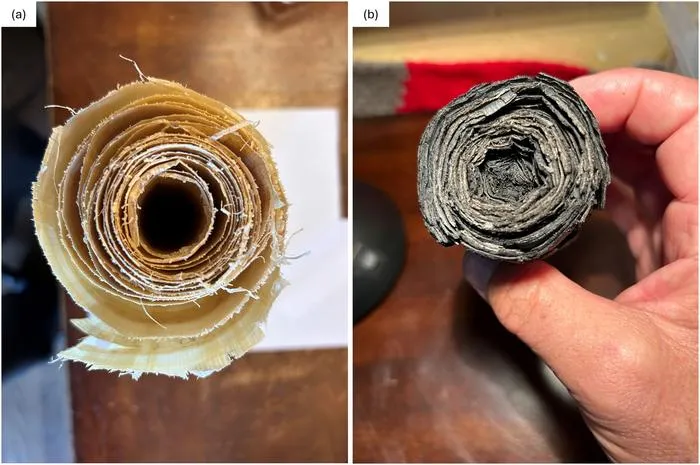
AI and X-ray Imaging Reveal Lost Texts in Ancient Roman Scrolls
AI and x-ray technology enable scientists to virtually read previously unreadable, carbonized Roman scrolls from Herculaneum.

•EurekAlert
AI’s Potential to Expand, Not Shrink, the Clinical Workforce
AI advancements may lead to more, not fewer, healthcare jobs, challenging common fears about workforce reductions in specialties like radiology.