
Back to all news
AI Model Predicts Microsatellite Instability and Immunotherapy Response from Histology
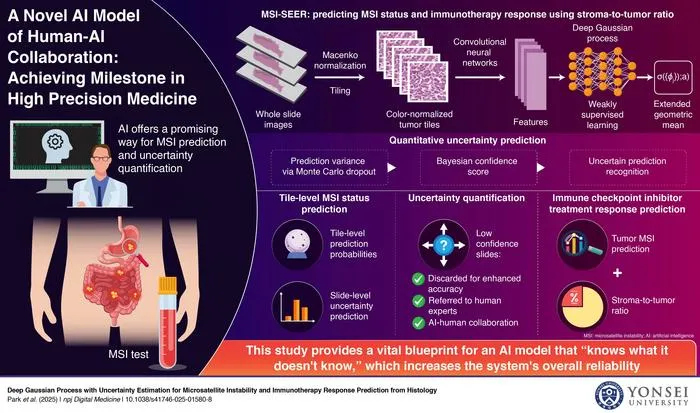
Yonsei University researchers introduced MSI-SEER, an AI model for MSI and immunotherapy response prediction from histology images of gastric and colorectal cancers.
Key Details
- 1MSI-SEER uses deep Gaussian process modeling to analyze H&E-stained whole-slide images.
- 2The model integrates uncertainty quantification, providing a Bayesian Confidence Score for each prediction.
- 3MSI-SEER flags uncertain cases for human review to enhance reliability and safety.
- 4Validated on large, racially diverse datasets, it achieved state-of-the-art MSI prediction accuracy.
- 5The model also predicts immune checkpoint inhibitor (ICI) response, integrating tumor MSI status and stroma-to-tumor ratio.
- 6Published in npj Digital Medicine on May 19, 2025.
Why It Matters
This innovation demonstrates the power of AI in pathology to provide clinically actionable predictions and to integrate uncertainty for safer AI-human collaboration in cancer diagnosis and therapy selection. The approach may serve as a model for broader use of AI in precision oncology workflows.

Source
EurekAlert
Related News
•EurekAlert
UVA's $4M NIH Grant Backs AI to Optimize Cardiac MRI Therapies
UVA secures $4 million NIH funding to develop GenStrain, an AI model using MRI data to personalize cardiac pacing therapies.

•EurekAlert
Machine Learning Models Predict Cancer Risk with Routine Health Data
Researchers developed machine learning models using routinely collected health data to predict individual risk for 20 common cancers, outperforming traditional methods for several cancer types.

•EurekAlert
Duke Receives $25M to Lead National Trustworthy AI Hub for Dementia and Aging
Duke University has launched a $25 million national center to make AI for aging and dementia clinically robust and trustworthy.