
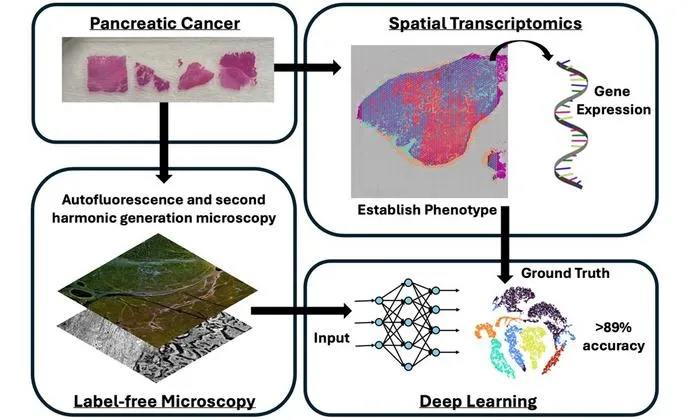
University of Arizona researchers achieved nearly 90% accuracy in pancreatic cancer phenotyping using label-free optical microscopy with deep learning AI.
Key Details
- 1Label-free optical microscopy paired with deep neural networks identified tissue phenotypes at over 89% accuracy in pancreatic cancer samples.
- 2Spatial transcriptomics served as the 'ground truth' for phenotypic classification.
- 3Traditional image analysis could not match the performance of AI methods, pointing to AI's necessity in extracting meaningful features from label-free images.
- 4This approach bypasses expensive and time-intensive molecular/genetic sequencing currently used in precision medicine.
- 5The work demonstrates a significant step toward more accessible and rapid phenotyping for cancer care.
Why It Matters
This study advances the use of imaging AI in precision medicine by offering a faster, less costly method for cancer phenotyping. It highlights the potential for optical imaging and AI to broaden access to personalized care by reducing dependence on resource-heavy molecular diagnostics.

Source
EurekAlert
Related News
•EurekAlert
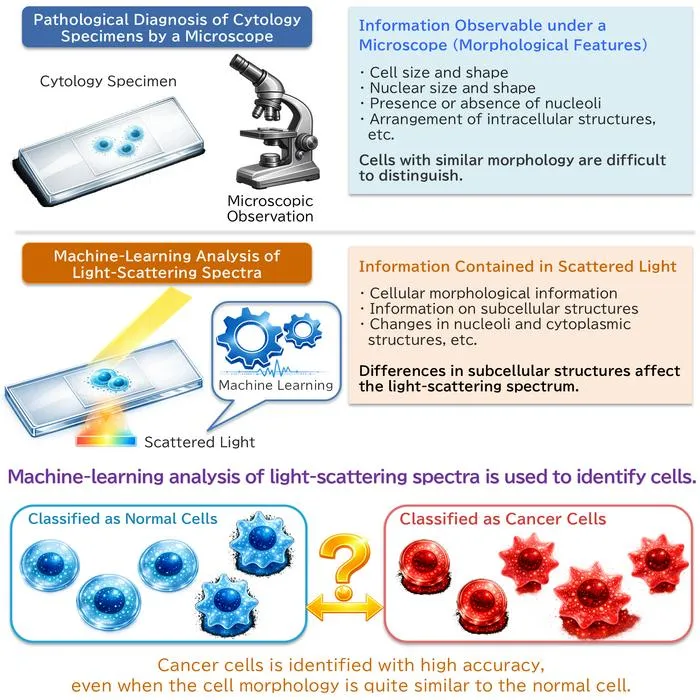
AI System Enhances Cancer Cell Detection via Light Scattering Spectra
Japanese researchers developed an AI system using light scattering spectra to improve cancer cell identification in cytology.
•EurekAlert
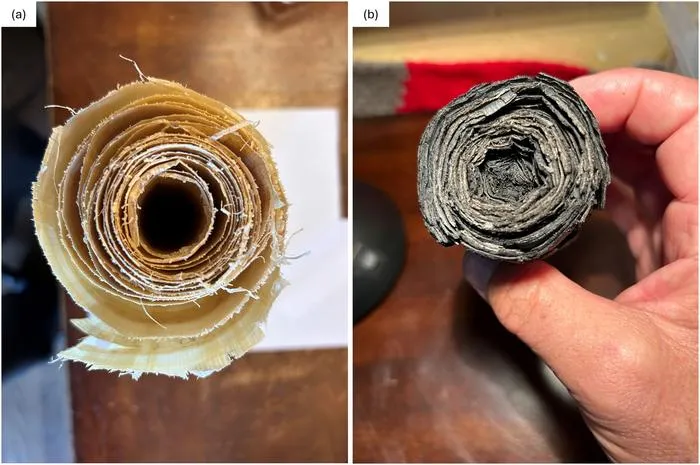
AI and X-ray Imaging Reveal Lost Texts in Ancient Roman Scrolls
AI and x-ray technology enable scientists to virtually read previously unreadable, carbonized Roman scrolls from Herculaneum.

•EurekAlert
AI’s Potential to Expand, Not Shrink, the Clinical Workforce
AI advancements may lead to more, not fewer, healthcare jobs, challenging common fears about workforce reductions in specialties like radiology.