
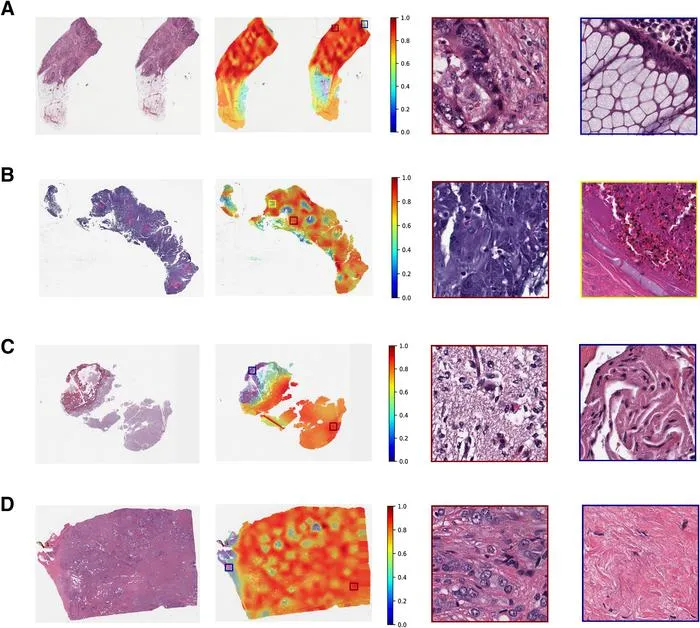
A novel AI analyzes whole histopathology images to predict cancer subtypes, TP53 mutations, and survival outcomes across 32 cancers.
Key Details
- 1The AI model uses routine H&E-stained whole slide images to simultaneously predict cancer subtype, TP53 mutation status, and survival outcomes.
- 2Model was trained on over 11,000 tumor cases from the Pan-Cancer Atlas with both imaging and molecular/genetic data.
- 3Achieved AUROC of 0.766 for TP53 mutation detection across 32 tumor types on an independent validation set (1,729 slides).
- 4Utilizes weakly supervised learning to identify meaningful patterns from slide-level labels without requiring detailed region annotations.
- 5Designed to be used as a complementary tool for screening/triage and decision-support, not as a replacement for molecular testing.
Why It Matters
This approach demonstrates how AI can link routine imaging with molecular diagnostics—potentially increasing testing accessibility, improving triage, and enhancing decision support in pathology workflows, especially in resource-constrained settings.

Source
EurekAlert
Related News

•EurekAlert
AI Model Combines ECG and Blood Tests to Spot Heart Transplant Rejection
An AI model integrating ECG data and blood biomarkers predicts heart transplant rejection with high specificity, reducing the need for invasive biopsies.

•EurekAlert
NIH Grant Funds AI Tool for Lung Cancer Discovery at Weill Cornell
Dr. Olivier Elemento receives an NIH Pioneer Award to develop an AI-human hybrid platform for cancer research, initially focusing on lung cancer using imaging and tissue data.
•EurekAlert
Study Shows AI Vision Misses Human-Like Perceptual Illusions
A York University study finds that AI vision systems lack the human-like perceptual shifts seen in biological vision during visual illusions.