
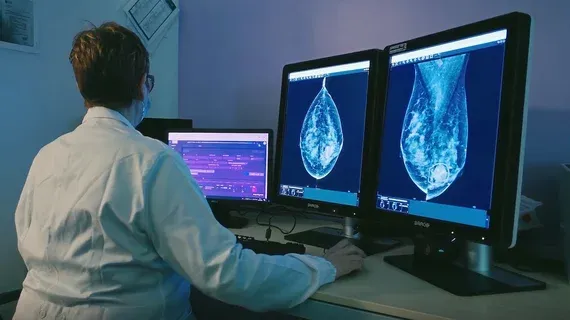
A longitudinal DBT-based deep learning model outperformed conventional mammography and clinical models for five-year breast cancer risk prediction.
Key Details
- 1Study leveraged 313,335 DBT exams from 161,077 women (2016–2020) at NYU Langone Health.
- 2DBT model's AUC for five-year risk prediction was 0.72 (independent test set), outperforming single-timepoint DBT (0.71), Mirai (0.69), and Tyrer-Cuzick (0.56, case-control cohort).
- 3Model classified 39.7% of extremely dense breasts as average risk (0.8% incidence in 5 years) and 14.8% of fatty breasts as high risk (2.6% incidence).
- 4Enhanced volumetric and longitudinal DBT imaging contributed to improved prediction.
- 5Authors call for external validation across diverse sites and prospective clinical studies.
Why It Matters
This research supports using AI on DBT images for dynamic and individualized breast cancer risk assessment, potentially refining personalized screening strategies and improving early cancer detection strategies in radiology practice.

Source
AuntMinnie
Related News

•Radiology Business
Multi-Vendor AI Adoption Delivers Efficiency Gains in Private Radiology
A large-scale European study shows that adopting multiple AI tools in private radiology practices leads to significant efficiency improvements.
•Radiology Business
Sweden Deploys AI as Standalone Second Reader for Mammography
Three Stockholm hospitals will adopt AI to fully replace radiologist second reads in breast cancer screening.

•AuntMinnie
AI Model Predicts Immunotherapy-Induced Pneumonitis From CT Scans
MD Anderson researchers developed the CIPHER AI model to predict pneumonitis in lung cancer patients using baseline CT scans, outperforming existing models.