| RadAISlice |
Weekly Updates in Radiology AI |
Good morning, there. OccuNet reached 97.5% sensitivity and 98.8% specificity in 2576 hip trauma patients. I see this as a practical safety net for an ED fracture that still gets missed. The workflow signal matters too, with radiologists reading 14.9% faster when aided by AI. Where would fracture AI add the most value in your emergency workflow?
Here's what you need to know about Radiology AI last week: Hip fracture AI shows reader level impact Prenatal ultrasound AI improves sensitivity FDA cyber rules add clearance pressure FDA clears AI cardiac MRI quantification Plus: 2 newly released datasets, 6 FDA approved devices & 4 new papers.
|
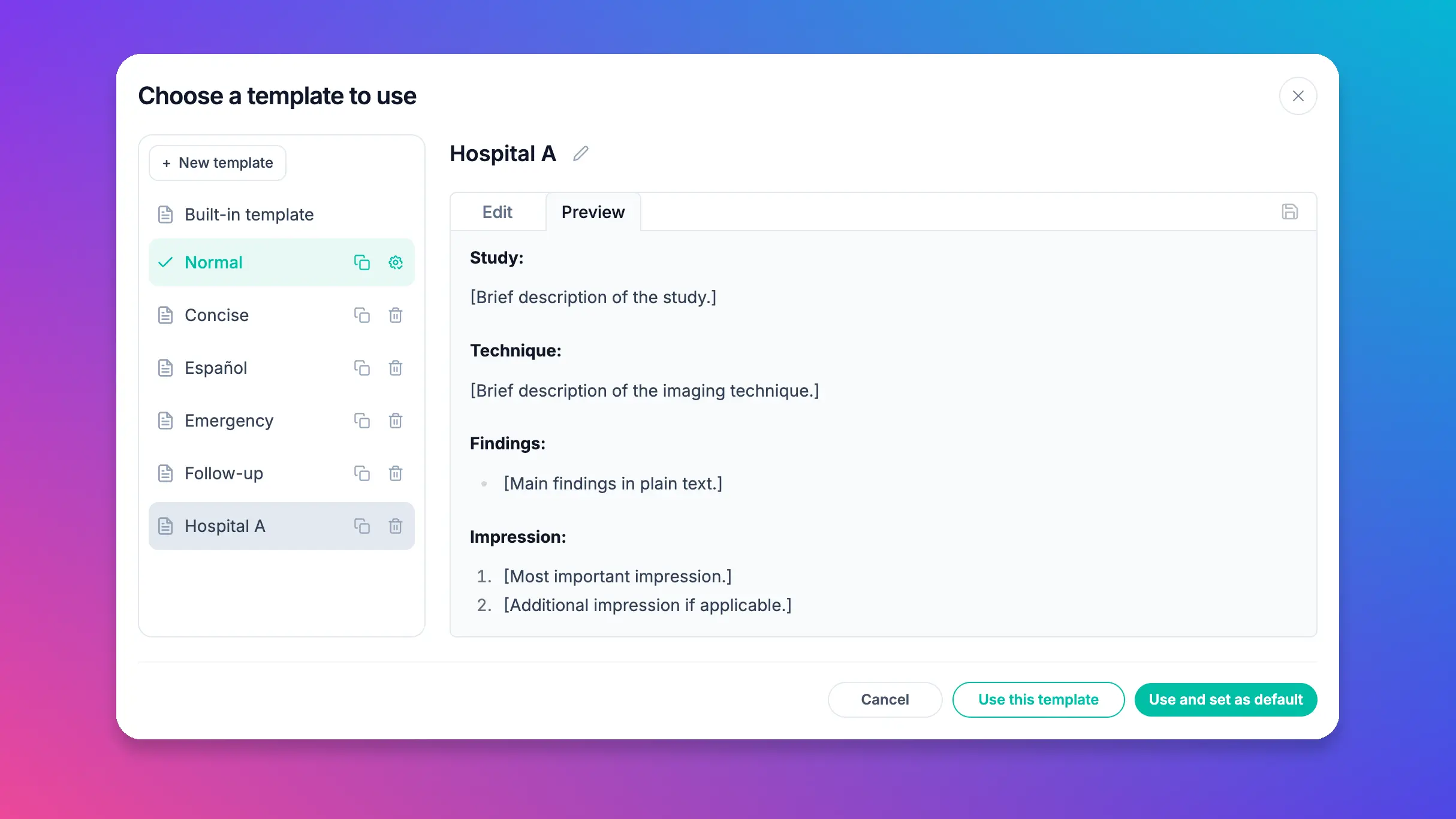
BUILT BY US Your report template library 📝 Previously, RadAIChat users could save only one custom report template.
Some radiologists asked for more flexibility when working with different reporting styles, languages, workflows, or client-specific formats.
We heard you. RadAIChat now includes a report template library, so you can save multiple templates, switch between them for each case, and keep one as your default.
|
🦴 Hip fracture AI shows reader level impact RadAISlice: This Radiology study pairs strong accuracy with a measurable reading workflow signal. The details: 2576 suspected hip trauma patients across 4 hospitals Pooled sensitivity 97.5%, specificity 98.8%, AUC 0.99 Occult or indeterminate fracture sensitivity reached 94.7% AI assistance cut radiologist reading time by 14.9%
Key takeaway: This feels close to a practical second reader for high risk ED hip films, especially when CT or MRI confirmation is not immediate. |
👶 Prenatal ultrasound AI improves sensitivity RadAISlice: This trial stands out because it tested AI assistance inside a real prenatal ultrasound workflow. The details: 1584 high risk pregnancy scans were completed at 5 centers Fetal based sensitivity increased by 0.087 Specificity met noninferiority with a 0.009 difference No AI related adverse events were reported
Key takeaway: The result supports AI as a targeted ultrasound safety aid, especially for complex fetal neuroanatomy in high risk screening. |
🛡️ FDA cyber rules add clearance pressure RadAISlice: This policy study links regulatory friction to networked imaging and treatment planning systems. The details: 83,675 FDA 510(k) records were analyzed through Aug 2, 2026 AI enabled product codes had about 24% longer clearance times Radiology codes drove the signal including CT, US, LLZ and MUJ The effect accumulated over 6 to 24 months
Key takeaway: For vendors and hospitals, cybersecurity evidence is becoming a real adoption variable, not just a submission checklist. |
❤️ FDA clears AI cardiac MRI quantification RadAISlice: This clearance is notable for turning cardiac MRI segmentation into a measurable workflow claim. The details: Heartvue.Proton generates 48 editable CMR measurements Outputs support heart and vessel analysis in cardiovascular disease Clinical evaluation compared AI outputs with expert consensus Measurement time fell nearly fivefold versus manual analysis
Key takeaway: For CMR services, the clearance points to AI adoption through quantification speed rather than autonomous diagnosis. |
MEDQA-MM (2026-09-08) Modality: Mixed: CT, MRI, X-ray | Focus: Multi-organ; general medicine | Task: Medical VQA; MCQ reasoning Size: 1,000 examples; scans/patients not specified. Built from 4,432 candidate items. Annotations: Multiple-choice answers with gold labels. Includes shortcut flags, repair provenance, and validation status. Institutions: University of Massachusetts Amherst; University of Massachusetts Lowell; et al. Availability: Highlight: Shortcut-mitigated benchmark designed to reduce text-only and options-only solution routes.
|
ThoughtMed-1M (Unspecified; planned upon publication) Modality: CT, X-ray, MRI, US, pathology, dermoscopy | Focus: Whole body; multi-organ | Task: VQA; visual grounding Size: 227,229 images from 68,946 clinical cases. Patient count not reported. Annotations: 1,018,472 long-form VQA pairs. Answers include clinical reasoning and embedded bounding-box grounding. Institutions: Sichuan University; Auckland University of Technology; et al. Availability: Restricted during peer review; planned public Figshare release.
Highlight: Large clinician-social-media-derived medical VQA dataset with stepwise reasoning and anatomical bounding boxes.
|
🏛️ FDA Clearances K261378 - FDA cleared AZmed Rayvolve AZchest for chest radiograph CAD with MRMC evidence of improved reader accuracy and time. K260584 - BoneMRI received 510(k) clearance to enhance MRI bone visualization in pelvis and spine with cortical error below 1.0 mm. K262622 - Hyperfine cleared Swoop updates using deep learning reconstruction for portable ultra low field head MRI. K253726 - United Imaging cleared uAngio AVIVA CX with AI denoising and stent enhancement for angiographic guidance. K261641 - Lower Limb AI cleared for CT based bone segmentation and alignment measures for knee osteotomy planning. K262506 - Remex cleared spine navigation accessories with CT and fluoroscopy registration accuracy under 2 mm and 2 degrees. Explore last week's 13 radiology AI FDA approvals.
|
📄 Fresh Papers doi:10.1097/RLI.0000000000001311 - Prospective brain MRI data showed DL corrected DWI improved distortion and matched RESOLVE lesion detectability in under half the scan time. doi:10.1093/bjr/tqag222 - After commercial PE AI deployment, incidental PE reporting on non CTPA CT rose from 0.35% to 0.63% across 11,690 scans. doi:10.1038/s43856-026-01897-9 - Across 816,183 chest radiographs, DINOv3 helped most at 512 pixels for adult small focal and boundary findings. doi:10.1002/jmri.70532 - A 1305 patient multicenter MRI pipeline segmented pediatric posterior fossa tumors with Dice 0.94 to 0.96. Browse 248 new radiology AI studies from last week.
|
That's it for today! Before you go we’d love to know what you thought of today's newsletter to help us improve the RadAISlice experience for you. |
|
👋 Quick favor: drag this into your Primary tab so you don’t miss next week. Or just hit Reply with one thought. See you next week.
P.S. We keep building free tools to accelerate your radiology work. What's the most time-consuming pain point in your day that we should help speed up? Reply and share your take so we keep building around you. |
|
|